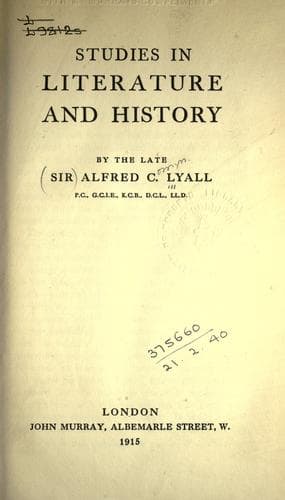
Studies in Literature and HistoryLyall, Alfred C., Sir
Religion
Studies in Literature and History
Lyall, Alfred C., Sir
English literature; History; Literature; Religion; Utilitarianism
Arnold 'agreed with Carlyle that the
Liberals greatly overrate Bentham, and the political economists
generally; the _summum bonum_ of their science is not identical with
human life ... and the economical good is often, from the neglect of
other points, a social evil.' Newman held that to allow the right of
private judgment was to enter upon the path of scepticism; and the
latest infidel device, he says, is to leave theology alone. He set up
the argument, well-worn but always impressive, that science gives no
certainty; and Mr. Stephen contends against it with the weapons of
empiricism:--
'The scientific doctrines must lay down the base to which all other
truth, so far as it is discoverable, must conform. The essential
feature of contemporary thought was just this: that science was
passing from purely physical questions to historical, ethical, and
social problems. The dogmatist objects to private judgment or free
thought on the ground that, as it gives no criterion, it cannot
lead to certainty. His real danger was precisely that it leads
irresistibly to certainty. The scientific method shows how such
certainty as is possible must be obtained. The man of science
advocates free inquiry precisely because it is the way to truth,
and the only way, though a way which leads through many errors.'
Mr. Stephen is himself a large-minded Utilitarian. He will have
nothing to do with a transcendental basis of morals; and the dogmatist
who dislikes cross-examination is out of his court. Dogmatic
authority, he says, stands only on its own assertions; and if you may
not reason upon them, the inference is that on those points reason is
against them. You may withdraw beyond this range by sublimating
religion into a philosophy, but then it loses touch with terrestrial
affairs, and has a very feeble control over the unruly affections of
sinful men. Newman himself resorted to scientific methods in his
theory of Development, that is, of the growth and evolution of
doctrine. We may agree that these destructive arguments have much
logical force, yet on the other hand such certitude as empiricism can
provide brings little consolation to the multitude, who require some
imperative command; they look for a pillar of cloud or fire to go
before them day and night, and a land of promise in the distance.
Scientific exposition works slowly for the improvement of ethics,
which to the average mind are rather weakened than strengthened by
loosening their foundations; and religious beliefs suffer from a
similar constitutional delicacy. Conduct is not much fortified by
being treated as a function of character and circumstance; for in
religion and morals ordinary humanity demands something impervious to
reasoning, wherein lies the advantage of the intuitionist.
Public-domain text, read in full here on John Shaqi.
Reviews
Reviews
No reviews yet
Be the first to share your thoughts on this work.
Elsewhere in the archive
Join the Discussion
Join the discussion
Sign in to leave a comment or review.
Sign InorCreate an account