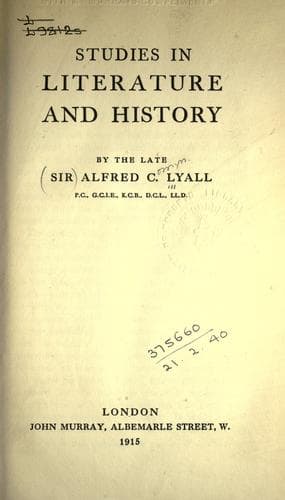
Studies in Literature and HistoryLyall, Alfred C., Sir
Religion
Studies in Literature and History
Lyall, Alfred C., Sir
English literature; History; Literature; Religion; Utilitarianism
Mr. Stephen, however, is well aware that empirical certitude will not
supply the place of religion. In his concluding pages he states,
fairly and forcibly, the great problems by which men are still
perplexed. Religion, as J. S. Mill felt, is a name for something far
wider than the Utilitarian views embrace.
'Men will always require some religion, if religion corresponds not
simply to their knowledge, but to the whole impression made upon
feeling and thinking beings by the world in which they must live.
The condition remains that the conception must conform to the
facts; our imagination and our desires must not be allowed to
over-ride our experience, or our philosophy to construct the
universe out of _a priori_ guesses.... To find a religion which
shall be compatible with all known truth, which shall satisfy the
imagination and the emotions, and which shall discharge the
functions hitherto assigned to the churches, is a problem for the
future.'
The Utilitarian doctrines, in short, though propagated by leaders of
high intellectual power, and inspired by a pure unselfish morality,
achieved little success in the enterprise of providing new and firmer
guidance and support to mankind in their troubles and perplexities.
But they were not content to look down from serene heights upon the
world, leaving the crowd
'Errare atque viam palantes quaerere vitae.'
They laboured devotedly to dispel ignorance and to advance knowledge;
they spared no pains to promote the material well-being of society.
They helped to raise the wind that filled the sails of practical
reform; they headed the attack upon legal and administrative abuses;
they stirred up the national conscience against social injustice; they
proclaimed a lofty standard of moral obligation. They laid down
principles that in the long run accord with human progress, yet in
their hopes of rapidly modifying society by the application of those
principles they were disappointed; for their systematic theories were
blocked by facts, feelings, and misunderstandings which had not been
taken into calculation. They were averse to coercion, as an evil in
itself; but though they would have agreed with Mr. Bright's dictum
that 'Force is no remedy,' they were latterly brought to perceive that
in another sense there is no remedy except force, and that the vested
interests and preconceptions of society make a stiff and prolonged
opposition to enlightened persuasion. They were disposed to rely too
confidently upon the spread of intelligence by general education for
preparing the minds of people to accept and act upon doctrines that
were logically demonstrable, and to reject what could not be proved.
Mr. Stephen has somewhere written that to support a religion by force
instead of by argument is to admit that argument condemns it. The
proposition is too absolutely stated even for the domain of spiritual
Public-domain text, read in full here on John Shaqi.
Reviews
Reviews
No reviews yet
Be the first to share your thoughts on this work.
Elsewhere in the archive
Join the Discussion
Join the discussion
Sign in to leave a comment or review.
Sign InorCreate an account