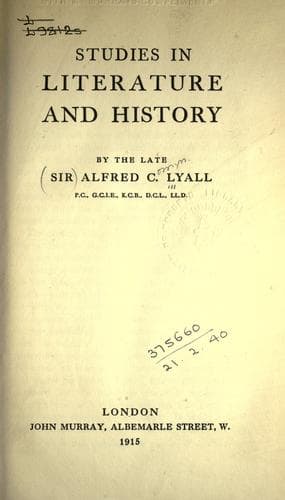
Studies in Literature and HistoryLyall, Alfred C., Sir
Religion
Studies in Literature and History
Lyall, Alfred C., Sir
English literature; History; Literature; Religion; Utilitarianism
Into the midst of a well-regulated, self-respecting modern society,
much moved by Tennyson's 'Idylls,' and altogether sympathetic with the
misfortunes of the blameless king--justly appreciative of the domestic
affection so tenderly portrayed by Coventry Patmore's 'Angel in the
House'--Mr. Swinburne charged impetuously with his _Poems and
Ballads_, waving the banner of revolt against conventional reticence,
kicking over screens and rending drapery--a reckless votary of
Astarte, chanting the 'Laus Veneris' and the worship of 'Dolores, Our
Lady of Pain.' From the calm and bright aspect of paganism he is
turning toward its darker side, to the mystic rites and symbolism
which cloaked the fierce primitive impulses of the natural man. The
burden of these first poems is chiefly the bitter sweetness of love,
the sighs and transports of those who writhe in the embrace of the
dread goddess, known by many names in all lands, or the glory of man's
brief springtide, when the veins are hot, soon to be cooled and
covered by frost and fallen leaves. In the clear ringing stanzas of
the 'Triumph of Time,' who sweeps away the brief summer of lovers'
delight, bringing them to autumnal regrets 'for days that are over and
dreams that are done,' and lastly to wintry oblivion, we have almost a
surfeit of voluptuous melancholy. In this, as in other poems, the sea,
changeful in mood, alternately fair and fierce, a bright smiling
surface covering a thousand graves, fascinating and treacherous, is
the mythical Aphrodite, the fatal woman, merciless to men. All this is
set out in lyrics which amaze the reader by their exuberance of
language, profusion of metaphor, and classic allusion; in rhymes that
strike on the ear like the clashing of cymbals. It is as if Atys and
his wild Maenads were flying through the quiet English woodlands. The
long-drawn, undulating lines, in a quieter strain, of the 'Hymn to
Proserpine' and of 'Hesperia,' with their subtle music, lay the reader
under their charm; but too many of these poems are tainted by a
flavour of morbidity, and the average Englishman is not easily thrown
by the most potent spells into a state of amorous delirium.
Public-domain text, read in full here on John Shaqi.
Reviews
Reviews
No reviews yet
Be the first to share your thoughts on this work.
Elsewhere in the archive
Join the Discussion
Join the discussion
Sign in to leave a comment or review.
Sign InorCreate an account