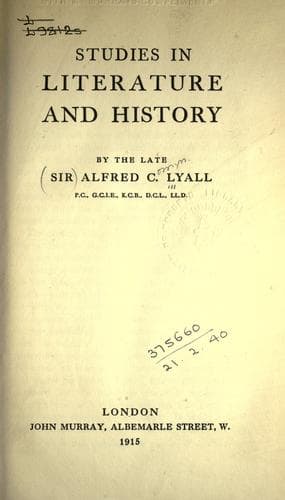
Studies in Literature and HistoryLyall, Alfred C., Sir
Religion
Studies in Literature and History
Lyall, Alfred C., Sir
English literature; History; Literature; Religion; Utilitarianism
The 'Hymn to Proserpine' is a fine conception of the champion of a
lost cause standing unmoved among the ruins of his Pantheon. But the
quiet dignity of his attitude is marred by the lines in which the
votary of fair forms turns with loathing from the new faith which has
conquered by the blood and agony of saints and martyrs. The violent
invective is like a red streak across the canvas of a picturesque and
highly imaginative composition. Yet if he had been reminded that
Lucretius, standing in the midst of paganism, sternly denounced the
evils and cruelties of religion, Mr. Swinburne would probably have
replied that the Roman poet, could he have been born again fourteen or
fifteen centuries later in his native country, would have found these
evils enormously increased, and that the sacrifice of Iphigenia in
Aulis was as nothing to the hecatombs of the Inquisition.
His intense imagination summons up a bright and luxurious vision of
the pre-Christian civilisation in Greece and Rome, as yet little
affected by the deeper spiritualism of Asia; he is absorbed in
contemplation of the beautiful sensuous aspect of the old
nature-worship, as it is represented by poetry and the plastic arts,
by singers and sculptors who (one may remark) knew better than to deal
with its darker and degrading side, its orgies and unabashed
animalism. And we may add that Mr. Swinburne would have done well to
follow the example, in this respect, of these great masters of his own
art; since his early defects and excesses are mainly due to his having
missed their lesson by disregarding the limitations which they
scrupulously observed.
When he reissued the _Poems and Ballads_, Mr. Swinburne took occasion,
as we have said, to reply, in a pamphlet, to the strictures and strong
protests which they had aroused. He was at some trouble to discover
the passages or phrases 'that had drawn down such sudden thunder from
the serene heavens of public virtue': he was comically puzzled to
comprehend why the reviewers were scandalised. He trampled with
sarcasm and scorn upon canting critics, and retorted that the prurient
prudery of their own minds suggested the impurities which they found
in works of pure art. There is nothing, he insists, lovelier, as there
is nothing more famous in later Hellenic art, than the statue of
Hermaphroditus, yet his translation of a sculptured poem into written
verse has given offence! One might reply that a subject which is
irreproachable, on the score of purity, in cold marble, may take a
very different colour when it is dilated upon in burning verse.
Public-domain text, read in full here on John Shaqi.
Reviews
Reviews
No reviews yet
Be the first to share your thoughts on this work.
Elsewhere in the archive
Join the Discussion
Join the discussion
Sign in to leave a comment or review.
Sign InorCreate an account