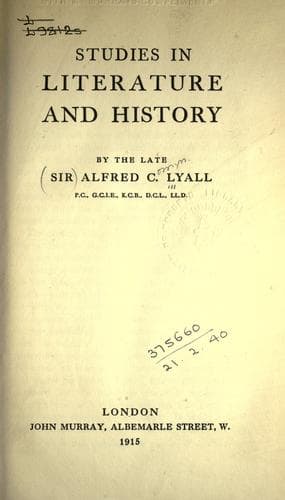
Studies in Literature and HistoryLyall, Alfred C., Sir
Religion
Studies in Literature and History
Lyall, Alfred C., Sir
English literature; History; Literature; Religion; Utilitarianism
The controversy had its humorous side; but we have no intention of
stirring up again the smoke and fire of battles fought long ago. Mr.
Swinburne held his ground defiantly, and the appearance of _Songs and
Ballads_, published in 1871, showed no signs of contrition, or of
concession to inveterate prejudices. In the course of the intervening
five years the empire of Napoleon III. had fallen with a mighty
crash; Italy had been united under one Italian dynasty; Garibaldi had
become famous, and the Papal States had been absorbed into the Italian
kingdom. This volume, which was dedicated to Joseph Mazzini, shows the
ardent enthusiasm for the triumph of liberty, intellectual and
political, which runs through all Mr. Swinburne's poetry. The 'Song of
the Standard,' the 'Halt before Rome,' the 'Marching Song,' the
'Insurrection of Candia,' are poems that reflect current events; and
the 'Litany of Nations' is the national anthem of peoples striving for
freedom. But his verse rises to its highest pitch of exultation in the
glorification of emancipation of Man. The final line of the 'Hymn to
Man' is
'Glory to Man in the highest, for Man is the master of things';
and in one stanza of 'Hertha' is condensed all the wild declamation
against deities and despots that pervades his poetry at this stage,
with his joy in the deification of humanity:
'A creed is a rod,
And a crown is of night;
But this thing is God,
To be man with thy might,
To grow straight in the strength of thy spirit, and live out thy life
As the light.'
Public-domain text, read in full here on John Shaqi.
Reviews
Reviews
No reviews yet
Be the first to share your thoughts on this work.
Elsewhere in the archive
Join the Discussion
Join the discussion
Sign in to leave a comment or review.
Sign InorCreate an account