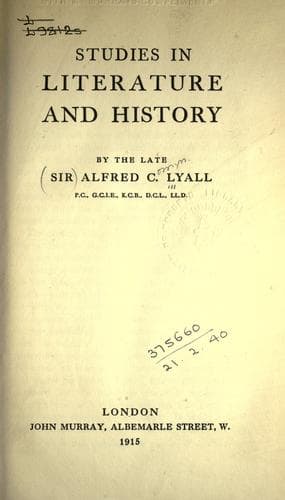
Studies in Literature and HistoryLyall, Alfred C., Sir
Religion
Studies in Literature and History
Lyall, Alfred C., Sir
English literature; History; Literature; Religion; Utilitarianism
We must not be understood to maintain that the Novel of Manners has
been, or is being, completely monopolised, as a department of light
literature, by women, for of course there are many men who are
achieving success in that field, among whom Henry James holds a high
place for distinction and delicacy of workmanship. And among certain
special branches in which women have not as yet competed at all, we
may mention the Sporting Novel, where provincial manners and the
humour of the coverside have been portrayed by Surtees with wonderful
exactitude and a kind of coarse yet irresistible comicality that
remind one of Fielding. It is true that he never moralises, as
Fielding does; but then the interjection by the author of moral
reflections went out, as we have said, with Thackeray. The description
of landscape drawn from nature occupies large and extending space in
the latter-day novel of manners, where it is used very sparingly as
subservient to character or situation, but commonly as an illustration
or pictorial background. Let us compare the two following extracts.
The first is from Jane Austen's _Mansfield Park_:
'Now we shall have no more rough road, Miss Crawford; our
difficulties are over. The rest of the way is such as it ought to
be. Mr. Rushworth has made it since he succeeded to the
estate.--Here begins the village. Those cottages are really a
disgrace. The church spire is reckoned remarkably handsome. I am
glad the church is not so close to the great House as often happens
in old places. The annoyance of the bells must be terrible. There
is the parsonage, a tidy-looking house, and I understand the
clergyman and his wife are very decent people. Those are
almshouses, built by some of the family. To the right is the
steward's house; he is a very respectable man. Now we are coming to
the lodge gates; but we have nearly a mile through the park still.
It is not ugly, you see, at this end; there is some fine timber,
but the situation of the house is dreadful. We go down hill to it
for half a mile, and it is a pity, for it would not be an
ill-looking place if it had a better approach.'
The second is from the opening pages of Mrs. Humphry Ward's
_Marcella_:
Public-domain text, read in full here on John Shaqi.
Reviews
Reviews
No reviews yet
Be the first to share your thoughts on this work.
Join the Discussion
Join the discussion
Sign in to leave a comment or review.
Sign InorCreate an account