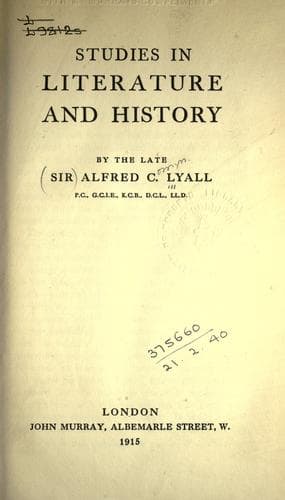
Studies in Literature and HistoryLyall, Alfred C., Sir
Religion
Studies in Literature and History
Lyall, Alfred C., Sir
English literature; History; Literature; Religion; Utilitarianism
In this respect, however, Mr. Swinburne may have found reason to
qualify, latterly, the absoluteness of his poetic principles. He has
been from the first a generous critic of those contemporary poets whom
he recognised as kindred souls. He awards unmeasured praise to Matthew
Arnold, while of his defects and shortcomings he speaks plainly. He
does loyal homage to Browning in a sequence of sonnets, and his
tribute to Tennyson was paid in a lofty 'Threnody,' when that noble
spirit passed away. For Victor Hugo he proclaimed, as all know,
nothing short of unbounded adoration--he is 'the greatest writer whom
the world has seen since Shakespeare'; though it may be doubted
whether in his own country Hugo now stands upon so supreme a pinnacle.
To other eminent men of his time his poetry accords admiration,
chiefly to the champions of free thought and of resistance to
oppression; and, in a poem entitled 'Two Leaders,' he salutes two
antagonists as he might do before crossing swords with them. The
leaders are not named; the first is evidently Newman:
'O great and wise, clear-souled and high of heart,
One the last flower of Catholic love, that grows
Amid bare thorn their only thornless rose,
From the fierce juggling of the priest's loud mart
Yet alien, yet unspotted and apart
From the blind hard foul rout whose shameless shows
Mock the sweet heaven whose secret no man knows
With prayers and curses and the soothsayers' art.'
The second is
'Like a storm-god of the northern foams
Strong, wrought of rock that breasts and breaks the sea,'
in whom we recognise Carlyle. They are the powers of darkness, doomed
to fall and to vanish before the light; yet their genius commands
respect and even sympathy.
'With all our hearts we praise you whom ye hate,
High souls that hate us; for our hopes are higher,
* * * * *
Honour not hate we give you, love not fear,
Last prophets of past kind, who fill the dome
Of great dead Gods with wrath and wail, nor hear
Time's word and man's: "Go honoured hence, go home,
Night's childless children; here your hour is done;
Pass with the stars, and leave us with the sun."'
The concise energy of these lines, their slow metrical movement,
invest them with singular weight and dignity. The poet is confronting
two representatives, in principle, of Force and Authority, whose
prototypes in bygone times would undoubtedly have sent him to the
scaffold or to the stake; nor is it improbable that both Carlyle and
Newman, though in all other opinions they differed widely, would have
agreed that a revolutionary firebrand and a pestilent infidel
deserved some such fate. The poet might console himself with the
reflection that they must have abhorred each other's principles quite
as much as they detested his own.
Public-domain text, read in full here on John Shaqi.
Reviews
Reviews
No reviews yet
Be the first to share your thoughts on this work.
Elsewhere in the archive
Join the Discussion
Join the discussion
Sign in to leave a comment or review.
Sign InorCreate an account