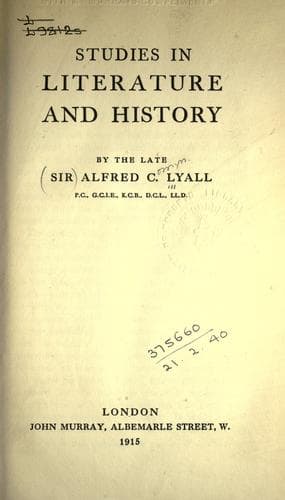
Studies in Literature and HistoryLyall, Alfred C., Sir
Religion
Studies in Literature and History
Lyall, Alfred C., Sir
English literature; History; Literature; Religion; Utilitarianism
In his later verse Mr. Swinburne still continues to wield his flaming
sword against priests and despots, against intellectual and political
servility. What may be termed the historical plea, the excuse for
ideas and institutions that they are the relics of evil days long
past, is no palliation for them to his mind; he would stamp them out
and utterly destroy them. In this respect his temperament has
unconsciously a strong tincture of the intolerance which he denounces;
he would sweep away Christianity as Christianity swept away
polytheism. Toward its Founder, as the type of human love and purity,
he is uniformly reverential; there is nothing in that supreme figure
that jars with that Religion of Humanity, which 'The Altar of
Righteousness' proclaims with high dithyrambic enthusiasm:
'Christ the man lives yet, remembered of man as dreams that leave
Light on eyes that wake and know not if memory bids them grieve.
* * * * *
Far above all wars and gospels, all ebb and flow of time,
Lives the soul that speaks in silence, and makes mute the earth
sublime.'
But of theology reigning by force and terror he is the implacable
enemy; and his intemperate violence leaves a stain on the bright
radiance of his poetry. It amounts to an artistic fault, undiminished
even in the later years which should have brought the philosophic
mind. Moreover, it has materially lessened the influence which so fine
a poetic genius should have exercised over the present generation,
among whom polemical ardour and bitterness may be thought to have
perceptibly cooled down, and to have become much less aggressive, in
science, philosophy, and literature, than among the preceding
generation. An age of tacit indifference, content with rationalistic
explanations, with the slow working of disillusion, dislikes and
discountenances outrageous scorn poured upon things that are
traditionally sacred; and to the English character extremes are always
distressing.
Public-domain text, read in full here on John Shaqi.
Reviews
Reviews
No reviews yet
Be the first to share your thoughts on this work.
Elsewhere in the archive
Join the Discussion
Join the discussion
Sign in to leave a comment or review.
Sign InorCreate an account