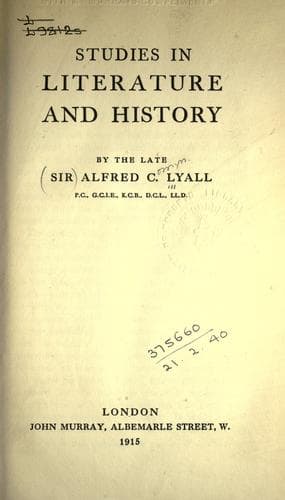
Studies in Literature and HistoryLyall, Alfred C., Sir
Religion
Studies in Literature and History
Lyall, Alfred C., Sir
English literature; History; Literature; Religion; Utilitarianism
Mr. Swinburne's dramatic work, at any rate, takes us out of the strife
and turmoil of theologic war; we are on firm historic ground, dealing
with authentic events and persons. The plays of _Chastelard_,
_Bothwell_, and _Mary Stuart_ form a trilogy in which the most
romantic and eventful period of Scottish history is presented; they
constitute the epic-drama of Scotland, to adopt a definition applied
by Victor Hugo to the tragedy of _Bothwell_. It is impossible, in this
article, to find space for an adequate criticism of these remarkable
productions. Every leading poet of the nineteenth century has made
excursions into the dramatic field. We doubt whether any of them has
come out of the adventure much better than Mr. Swinburne. All of them
have given us, each in his own way, fine poetry, and, if we except
Byron, they have shown that the masters of lyrical music can strike
with power the high chords of blank verse. None of them have produced
plays that took any hold of a theatrical audience; in most cases they
were not intended for the stage.
The play of _Chastelard_ is too deeply saturated with amorous essences
throughout to be forcibly dramatic. The hero is in a high love-fever
from first to last, the passionate strain becomes monotonous, and
though he dies to save the Queen's honour, our minds are not purged
with much pity for him. In the long historical drama of _Bothwell_,
which has twenty-one scenes in its two acts, we have spirited
portraits of the fierce nobles who surrounded Mary Stuart during her
brief and distracted reign. The love passages are pauses in a course
of violent action, the assassination of Rizzio, the murder of Darnley
are not overcoloured melodramatically, and the scenes in and about the
Kirk of Field are darkened with the shadow of Darnley's imminent fate.
But Darnley's dream, presaging his coming doom, inevitably recalls the
dream of Clarence, and cannot but suffer from the reminiscence. We
might have something to say on the metrical construction of
Swinburne's blank verse, for he shares with Tennyson, though in a
minor degree, the distinction of having enlarged its scope and varied
its measure. But the subject would demand careful comparative
examination and analysis of different styles, such as is to be read,
with profit to all students of the art poetic, in Mr. J. B. Mayor's
_Chapters on English Metres_.
Public-domain text, read in full here on John Shaqi.
Reviews
Reviews
No reviews yet
Be the first to share your thoughts on this work.
Elsewhere in the archive
Join the Discussion
Join the discussion
Sign in to leave a comment or review.
Sign InorCreate an account