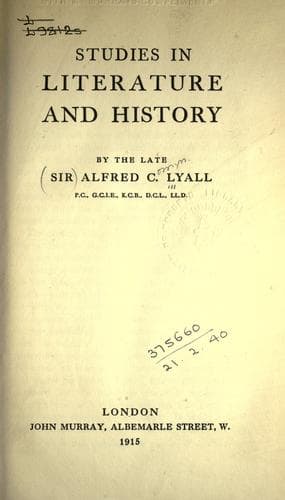
Studies in Literature and HistoryLyall, Alfred C., Sir
Religion
Studies in Literature and History
Lyall, Alfred C., Sir
English literature; History; Literature; Religion; Utilitarianism
From these causes it has resulted that Mr. Swinburne does not, in our
opinion, now hold the position or command the influence which would
otherwise be accorded to one who may be reckoned the chief lyrical
poet of the second half of the nineteenth century; for after the
publication, in 1855, of _Maud_, Tennyson had passed his lyrical
climax, and Mr. Swinburne's superiority, as a lyrist, over all other
writers of that period is incontestable. His neo-paganism, moreover,
jars upon the realistic modernity of a generation for whom primitive
symbolism is obsolete as a form of expression, and whose prevailing
thought is too profoundly rationalistic to be attracted by a pagan
paradise. All this is to be regretted, since Mr. Swinburne undoubtedly
has the pagan virtues. His aspirations are concentrated on ideals that
ennoble the present life, on justice, inflexible courage, patriotism,
the unsophisticated intelligence; he loves liberty and he hates
oppression in all their shapes. He is throughout an optimist, who
believes and predicts that a clearer and brighter prospect is before
humanity. To Mr. Swinburne, in short, may be applied the words with
which Matthew Arnold summed up his essay upon Heine: 'He is not an
adequate interpreter of the modern world; he is a brilliant soldier in
the liberation war of humanity.' And future generations may remember
him as the poet who passed on to them the message of his spiritual
forefather, Shelley:
'O man, hold thee on in courage of soul
Through the stormy shades of thy worldly way;
And the billows of clouds that round thee roll
Shall sleep in the light of a wondrous day,
When heaven and hell shall leave thee free
To the universe of destiny.'
FOOTNOTES:
[31] _The Poems of Algernon Charles Swinburne._ In six volumes. With a
dedicatory epistle to Theodore Watts-Dunton. London, Chatto and
Windus, 1904.--_Edinburgh Review_, October 1906.
[32] 'Out, hyperbolic fiend! how vexest thou this man?'--_Twelfth
Night._
[33] Dedicatory Preface.
[34] Dedicatory Preface.
[35] _Holiday and Other Poems_, 1906.
[36] Note on Poetry, p. 144.
[37] _Essays and Studies_, 1867.
FRONTIERS ANCIENT AND MODERN[38]
Public-domain text, read in full here on John Shaqi.
Reviews
Reviews
No reviews yet
Be the first to share your thoughts on this work.
Elsewhere in the archive
Join the Discussion
Join the discussion
Sign in to leave a comment or review.
Sign InorCreate an account