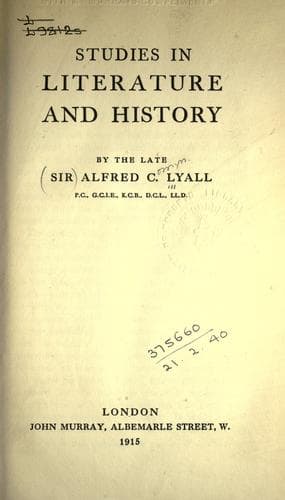
Studies in Literature and HistoryLyall, Alfred C., Sir
Religion
Studies in Literature and History
Lyall, Alfred C., Sir
English literature; History; Literature; Religion; Utilitarianism
It may be doubted whether many students of history are aware that the
demarcation of frontiers, of precise lines dividing the possessions of
adjacent sovereignties and distinguishing their respective
jurisdictions, is a practice of modern origin. At the present time it
is the essential outcome of territorial disputes, it is the operation
by which they are formally settled at the end of a war: it registers
conquests and cessions; and occasionally it has been the result of
pacific arbitration. Among compact and civilised nationalities an
exterior frontier, thus carefully defined, remains, like the human
skin, the most sensitive and irritable part of their corporate
constitution. The slightest infringement of it by a neighbouring Power
is instantly resented; to break through it violently is to be
inflicting a wound which may draw blood; and even interference with
any petty State that may lie between the frontiers of two great
governments is regarded as a serious menace.
The whole continent of Europe has now been laid out upon this system
of strict delimitation. Yet it may be maintained that among the
kingdoms of the ancient world no such exact and recognised
distribution of territory existed; and, further, that up to a very
recent period none of the great empires in Asia had any boundaries
that could be traced on a map. Their landmarks were incessantly
shifting forward or backward as their military strength rose or fell;
and where their territories marched with some rough mountainous tract
inhabited by warlike tribes, they were perpetually plagued by petty
warfare on a zone of debateable land. On both sides some temporary
intrusion upon or occupation of country held by a neighbour, which
would now be the signal for mobilising an army, was treated as a
trespass of small importance, to be resented and rectified at leisure.
It is true that in earlier times the Romans marked off distinct
frontiers, and guarded them by military posts; but their policy was to
acknowledge no frontier power with equal rights, and their actual
political jurisdiction usually extended far beyond their lines of
defence, which were advanced or withdrawn as political or military
considerations might require. In fact, the Roman empire, like the
British empire in Asia, was a great organised State, surrounded, for
the most part, by small and weak principalities, or by warlike tribal
communities, and it grew by a natural process of inevitable expansion.
The emperors were often reluctant to enlarge their possessions; but
the raids and incursions of intractable barbarians, or the revolt of
some protected chiefship, frequently left them no option but to
conquer and annex. They soon found themselves compelled to overstep
the limits of empire prescribed by the policy of Augustus, and to lay
down an advanced frontier in the lands beyond the Rhine and the
Danube.
Public-domain text, read in full here on John Shaqi.
Reviews
Reviews
No reviews yet
Be the first to share your thoughts on this work.
Elsewhere in the archive
Join the Discussion
Join the discussion
Sign in to leave a comment or review.
Sign InorCreate an account