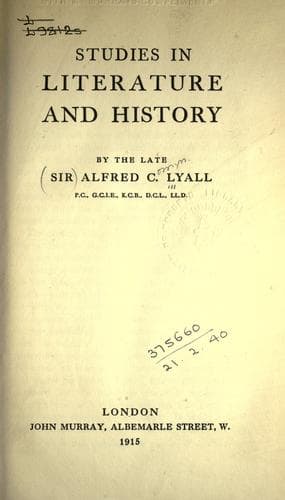
Studies in Literature and HistoryLyall, Alfred C., Sir
Religion
Studies in Literature and History
Lyall, Alfred C., Sir
English literature; History; Literature; Religion; Utilitarianism
had established by the end of the century the Cossack line of forts,
military colonies and plantations of armed cultivators, linked
together to form a barrier against the incursions and marauding raids
of the wild folk in the woods and mountains in front of them, and
gradually strengthened and supported by stations of regular troops in
the background. On the south of the central mountain ranges the
Russians held Georgia, inhabited by Christian races whom the Russians
had liberated from the Turkish or Persian yoke before the close of the
eighteenth century, and who ever afterwards remained loyal subjects of
the Czar. The Georgian road which traversed the whole Caucasian region
from north to south, formed a most important line of communication
which was never seriously interrupted. To the south-east, when the
nineteenth century opened, lay Mohammedan khanates, vassals of Persia;
on the south-west were the semi-independent pachaliks of the Ottoman
empire.
We must pass over, reluctantly, Mr. Baddeley's very interesting sketch
of the gradual approach made by Russia toward the Caucasus during the
eighteenth century, which may be said to have begun in earnest with
the expedition of Peter the Great, who led an army to the Caspian
shore and captured Derbend about 1722. This threatening movement upon
the confines of Asia inevitably involved Russia in war with the Turks
and with the Persians, for whom the Caucasian mountains represented a
great fortress, barring the onward march of a powerful Christian
empire toward their dominions. For the Russians, on their side, it
became of vital importance to break through the barrier that separated
them from Georgia, to occupy the country between the two seas, and to
make an end of the perpetual warfare with the tribes, who kept their
frontier on the Cossack line in unceasing agitation and disorder, and
were a standing menace to the Christian population of Georgia. It
should be understood, however, that the Cossacks discharged their
duties of watch and ward after a very rough fashion, raiding and
fighting on their own account, making incursions upon their Mohammedan
neighbours in retaliation for attacks and forays, and laying waste the
enemy's country with the bitter vindictiveness of antagonistic races
and religions.
Public-domain text, read in full here on John Shaqi.
Reviews
Reviews
No reviews yet
Be the first to share your thoughts on this work.
Elsewhere in the archive
Join the Discussion
Join the discussion
Sign in to leave a comment or review.
Sign InorCreate an account