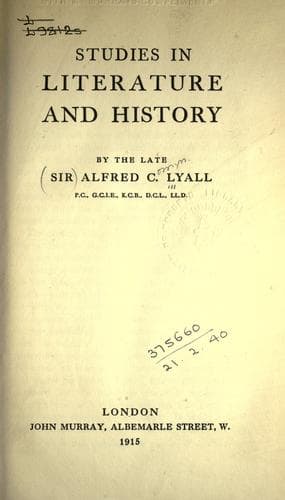
Studies in Literature and HistoryLyall, Alfred C., Sir
Religion
Studies in Literature and History
Lyall, Alfred C., Sir
English literature; History; Literature; Religion; Utilitarianism
To Englishmen, therefore, whose experience of this situation is long,
varied, and actual, Mr. Baddeley's book on the Russians in the
Caucasus should be of exceptional interest. It is indeed well worth
studying by those upon whom, whether at home or in India, has been
imposed the arduous duty of superintending our policy in dealing with
the Afghan tribes for the protection of our Indian districts. It is
true that the conditions and circumstances, military and political,
under which Russia prosecuted her long war with the Caucasian
mountaineers, rendered her position in many respects different from
that in which the English found themselves when they first came into
contact with Afghanistan, and which has changed very little in the
course of sixty years. The aims and purposes of the two governments
were by no means the same. Yet in both cases we have a story of the
obstinate resistance opposed by fierce and free clans to the arms of a
powerful empire, of perilous campaigns amid rugged hills and passes,
of the hazards and misfortunes to which disciplined troops are always
liable when they encounter resolute and fanatical defenders of a
difficult country.
Mr. Baddeley's book contains an authentic narrative, founded on
diligent study of official documents and on the accounts of those who
took part in the fighting, of the operations by which the Mohammedan
tribes of the Caucasus were finally subdued, after fierce and
protracted resistance, by Russian armies, and their country was
annexed to the dominions of the Czar. His knowledge of this region is
evidently derived from personal exploration; and in the Introduction
to his book he has spared no pains to explain to his readers its
geographical position, its topography, its physical features, and the
extraordinary diversity of races and languages which it contained. We
learn that the chain of mountains which was originally known by the
name of the Caucasus stretches, with a total length of 650 miles, from
the Caspian to the Black Sea. Toward the north is a tract of dense
forest, intersected by numerous streams flowing down from the
mountains; and beyond lies the high plateau of Daghestan, 'through
which the rivers have cut their way to a depth often of thousands of
feet, the whole backed and ribbed, south and west, by mountain ranges
having many peaks often over 13,000 feet in height.' In the forest
tract, to which the Russians gave the name of Tchetchnia, their armies
were constantly entangled; and their difficulties in reducing the
inhabitants to subjection were quite as great as in conquering the
highland tribes of Daghestan. Throughout the eighteenth century, and
even earlier, the Russians had been pushing southward toward the Black
Sea and the Caspian, and had gradually taken under their authority and
protection the Cossack tribes who were settled on the steppes that
spread along the northern border of the Caucasus. On this border they
Public-domain text, read in full here on John Shaqi.
Reviews
Reviews
No reviews yet
Be the first to share your thoughts on this work.
Elsewhere in the archive
Join the Discussion
Join the discussion
Sign in to leave a comment or review.
Sign InorCreate an account