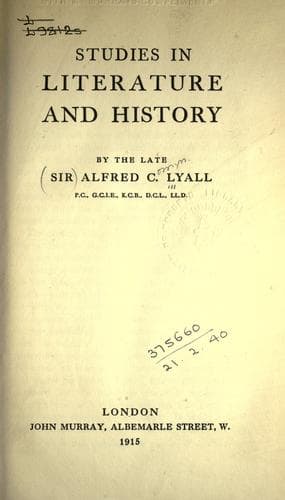
Studies in Literature and HistoryLyall, Alfred C., Sir
Religion
Studies in Literature and History
Lyall, Alfred C., Sir
English literature; History; Literature; Religion; Utilitarianism
On the Cossack line, when Yermoloff assumed charge of operations,
'there was no open warfare, but there was continual unrest. No man's
life was safe outside the forts and stanitzas; robbery and murder were
rife; raiding parties, great and small, harried the fields, the farms
and the weaker settlements.' To this state of things he was resolved
to put an end. He built fortresses, pushed forward his outposts,
formed moving columns of troops, and assiduously trained his soldiers
to the peculiar conditions of warfare on this borderland. The Russian
regiments, like the Roman legions, were often stationed in their
camps or garrisons for twenty-five years; and for the service required
of them their efficiency was admirable. For ten years Yermoloff
carried on this tribal war with inflexible rigour, by expeditions to
punish some marauding village, which was razed to the ground, and most
of the men, women and children burnt or killed after defending the
place with the fury of despair; by night marches to surprise and storm
the hill forts; by exterminating bands of brigands; and more than once
by laying deathtraps for notorious rebels or fanatics. There can be no
doubt that this system of ruthless chastisement, of beating down the
enemy's defences by sharp and rapid strokes, by sudden and daring
inroads into the heart of their country, intimidated the tribes, and
went far toward compelling them to sullen acquiescence in the Russian
overlordship. Of the petty independent chiefships some were seized
forcibly, others submitted and paid tribute. The Russians were
advancing step by step into the interior of the country, piercing it
with roads and riveting their hold on it by throwing forward their
chain of connected forts. By 1820 Yermoloff appears to have convinced
himself that in a few years the whole of the Caucasus--mountain and
forest--would be permanently conquered and pacified; and for some time
after that date there was little or no fighting, though the border was
frequently disquieted by outbreaks that were sternly crushed. With the
Persians and the Turks there was an interval of peace.
Public-domain text, read in full here on John Shaqi.
Reviews
Reviews
No reviews yet
Be the first to share your thoughts on this work.
Elsewhere in the archive
Join the Discussion
Join the discussion
Sign in to leave a comment or review.
Sign InorCreate an account