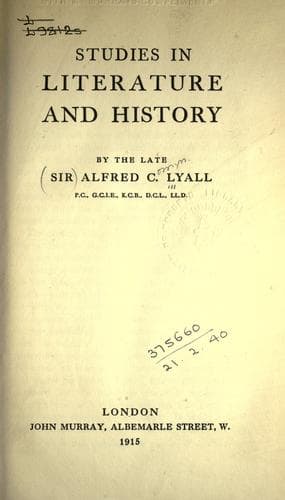
Studies in Literature and HistoryLyall, Alfred C., Sir
Religion
Studies in Literature and History
Lyall, Alfred C., Sir
English literature; History; Literature; Religion; Utilitarianism
But the harsh measures taken by the Russians to bring the forest
tribes under their authority were bitterly resented; and in 1824 two
of their generals were fatally stabbed in Tchetchnia by one of several
villagers whom they were disarming. This murder was avenged by
Yermoloff, as usual, relentlessly, but it was his last campaign in
the Caucasus. In 1826 the Persians, who had been incensed by
Yermoloff's rough ways on their frontier and by his insolent
diplomacy, invaded Russian territory with a strong army. The Russians
were unprepared, and at first could only act on the defensive. The
flames of insurrection at once broke out among the tribes; the whole
country fell back into confusion, and the Emperor Nicholas, holding
Yermoloff responsible for this disastrous state of affairs,
reprimanded and recalled him. He lived in retirement until 1861,
revered by the Russian nation as the type and model of a valiant
soldier and a devoted patriot who won brilliant victories and
conquered large territories for the empire. But on his system and its
consequences Mr. Baddeley pronounces a judgment which in fact points
the moral of his whole narrative, and explains the history of the
events that followed Yermoloff's departure:
'He gained brilliant victories at slight cost; and brought for a
time the greater part of Daghestan under Russian dominion.... He
absorbed the Persian and Tartar khanates, and treated Persia with
astonishing arrogance. But it was these very measures and successes
that led, on the one hand, to the Persian War and the revolt of the
newly-acquired provinces; on the other, to that great outburst of
religious and racial fanaticism which, under the banner of
Muridism, welded into one powerful whole so many weak and
antagonistic elements in Daghestan and Tchetchnia, thereby
initiating the bloody struggle waged unceasingly for the next forty
years. Daghestan speedily threw off the Russian yoke, and defied
the might of the mother empire until 1859. In Tchetchnia mere
border forays conducted by independent partisan leaders ...
developed into a war of national independence under a chieftain as
cruel, capable, and indomitable as Yermoloff himself.'
The Persian War ended in 1828, but in the same year hostilities broke
out with Turkey, involving the Russian troops on the Georgian frontier
in hard and hazardous fighting, which lasted, with a great expenditure
of men and money, until peace was concluded in 1829. From that year
until 1854, when the Crimean War began, Russia had a free hand in the
Caucasus, and applied her strength with inexorable energy to its
subjugation. And it is to the rise and spread of the ferocious
enthusiasm which Mr. Baddeley has called _Muridism_ that he attributes
the striking fact that the complete conquest of the country was only
accomplished in 1864--that the tribes held out against the forces of
the Russian empire for more than thirty years.
Public-domain text, read in full here on John Shaqi.
Reviews
Reviews
No reviews yet
Be the first to share your thoughts on this work.
Elsewhere in the archive
Join the Discussion
Join the discussion
Sign in to leave a comment or review.
Sign InorCreate an account