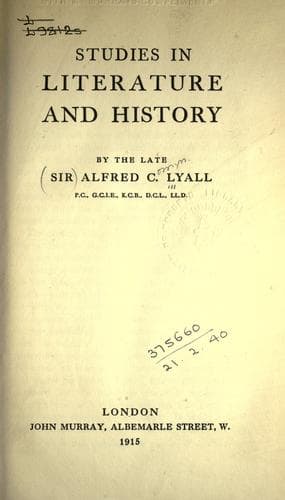
Studies in Literature and HistoryLyall, Alfred C., Sir
Religion
Studies in Literature and History
Lyall, Alfred C., Sir
English literature; History; Literature; Religion; Utilitarianism
'A withering fire from hundreds of rifles mowed down the troops
like grass. Their gallant commander, Yeodskeemoff, fell dead,
pierced by a dozen bullets. The captain of the grenadier company
strode over his body and gained the top of the breach, to fall in
turn; the men were exasperated rather than daunted; a Danish
officer, more fortunate and not less brave than his predecessors,
led them forward, and the wall was won. In front was the first row
of low _saklias_ (stone houses) and, climbing their walls, the
attackers rushed forward, when to their horror the ground gave way
beneath their feet, and amid shouts of demoniac laughter they fell
on to the swords and daggers of the Murids below. The flat roofs
had been taken off the whole row of houses and replaced by layers
of brushwood thinly covered with earth; every house, in fact, was a
death-trap.'
Nevertheless the troops came on, and most of them got inside the
village, but they were entangled in the labyrinth of narrow streets,
and were obliged to retire. Another assault ended with another
repulse, 'and the victorious Murids, driving the broken columns before
them, followed until stopped by the bayonets of the reserve.'
Vorontzoff had now been twice beaten off by Shamil: he had been
repulsed, and had nearly lost his army in the forests; his troops had
been hurled back with slaughter from the mountain fort. Next year he
despatched another large army, furnished with heavy artillery, against
Ghergebil, which drove out the Murid garrison by a tremendous
bombardment, but retired without occupying the place. During the next
few years, though wild work went on as usual along the border, where a
sharp guerilla warfare was kept up, neither Shamil nor Vorontzoff
attempted to strike any decisive blow. But the lowlands were
devastated by perpetual incursions and reprisals, and the forest
tribes, placed between two fires, driven to choose between the Murids
and the Russians, gradually transferred their allegiance to the side
best able to protect them, and migrated northward across the Russian
line. The uninhabited woodlands became a kind of neutral ground which
neither side cared to occupy; and from this time Shamil's sphere of
action was confined to the mountains of Daghestan. Then, in 1854,
began the war in the Crimea, when according to Mr. Baddeley the Allies
might have ruined Russia in the Caucasus by making common cause with
Shamil and supporting him vigorously. But England and France were
absorbed in besieging Sebastopol, and Omar Pasha's Transcaucasian
campaign was undertaken too late for any effective result. Mr.
Baddeley considers that in neglecting their opportunity of backing
Shamil the Allies made a strategic blunder; yet we agree with him that
this is not to be regretted. For the credit of civilisation it is well
that they did not let loose the savage Mohammedan fanatics upon
Public-domain text, read in full here on John Shaqi.
Reviews
Reviews
No reviews yet
Be the first to share your thoughts on this work.
Elsewhere in the archive
Join the Discussion
Join the discussion
Sign in to leave a comment or review.
Sign InorCreate an account