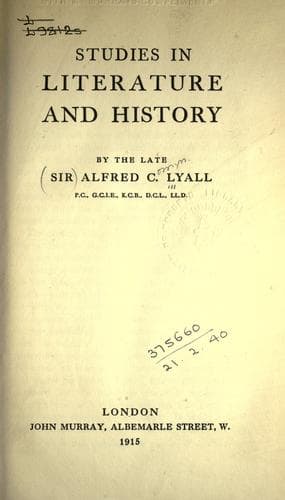
Studies in Literature and HistoryLyall, Alfred C., Sir
Religion
Studies in Literature and History
Lyall, Alfred C., Sir
English literature; History; Literature; Religion; Utilitarianism
Christian Georgia and the peaceful Russian settlements beyond the
frontier, to their own dishonour, and to the misery of the people whom
Russia was protecting. Shamil did make one foray into Georgia, when a
party of his men carried off two Georgian princesses, the wife and
sister of the Viceroy, who were kept by Shamil in rigorous captivity
and treated cruelly for eight months while negotiations went on for
their release. His object was to exchange them for his son, who had
been captured by the Russians some fourteen years earlier, had been
brought up from childhood among them, and at this time was a
lieutenant in a Russian lancer regiment. As Shamil demanded not only
his son but a large ransom for the princesses, there was long haggling
over the money, but this point was at last settled, and the exchange
took place on the banks of the river. The princesses and Jamal-ud-deen
crossed from opposite banks to the escorts appointed to deliver and
receive them; the youth was then made to change his Russian uniform
for a native dress and rode up the hill to his father, who welcomed
him with tears and embraces.
The scene must have been strangely picturesque; and the whole story
illustrates the accidents and incongruities of warfare between nations
whose standard of morals and manners is entirely different. The
abduction and brutal treatment of the princesses were altogether
contrary to the rules and ideas of modern belligerents; but what would
have been to the Russians a foul disgrace was to the rude Caucasian
chief no more than a simple and justifiable method of extorting his
son's release. On the other hand the Russians had bred up their
captive at their capital; they had converted him to their own social
habits and ways of life. And the sequel is instructive for those who
have yet to learn how completely European education may incapacitate
an Asiatic from returning to associate with his own people, how
effectually it may obliterate the early influences of race and
religion.
'The fate of Jamal-ud-deen was indeed a sad one. Brought up from
the age of twelve years in St. Petersburg and entered in the
Russian army, he was now a stranger to his own father, an alien in
the land of his birth, and totally unfitted to resume his place
among a semi-barbarous people. He had looked forward to his return
with the gloomiest forebodings, which were fully justified by the
event. As a matter of fact, there could be little real sympathy
between his fellow-countrymen and himself; they soon began to look
upon him with suspicion and distrust. Even Shamil was estranged
when he found his son imbued with Russian ideas, and convinced of
Russia's right to the extent of counselling surrender.' ... Nothing
'could reconcile him to the change from civilisation to barbarism;
he grew melancholy, fell into a decline, and died within three
years.'
Public-domain text, read in full here on John Shaqi.
Reviews
Reviews
No reviews yet
Be the first to share your thoughts on this work.
Elsewhere in the archive
Join the Discussion
Join the discussion
Sign in to leave a comment or review.
Sign InorCreate an account