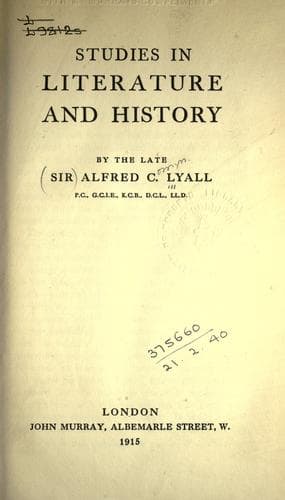
Studies in Literature and HistoryLyall, Alfred C., Sir
Religion
Studies in Literature and History
Lyall, Alfred C., Sir
English literature; History; Literature; Religion; Utilitarianism
a hard-fighting and intractable people, and on the farther side of
these mountains stands the rival European Power whose policy it had
been always to retard and obstruct the Russian advance across the
Asiatic Continent. We may conjecture that if Afghanistan had been
left, as the Caucasus was left after the Crimean War, isolated and
obliged to rely on its own resources for defence, the drama of the
Caucasian wars would have been repeated. The Russians would have
besieged and reduced without great difficulty this second mountain
fortress; and after another similar though less protracted struggle
the Afghans would have undergone the same fate as the Daghestanis. The
Czar's rulership, solidly established in the two natural strongholds
that stand on either side of the great central plains, and command,
east and west, the exits and entrances, would have been supreme
throughout Mohammedan Asia.
That the Russian armies were forced to halt on the edge of Afghanistan
is thus a point of cardinal importance, and it marks a turning-point
in the career of her expansion. It also produced a situation that is
the outcome of the different strategy adopted by England and Russia
respectively, in circumstances not otherwise very dissimilar. For
whereas the Russians had been compelled by imperative political and
military exigencies to conquer and occupy the Caucasian highlands, the
policy of the British Government has always been not to subjugate
Afghanistan, but to preserve its independence and to fortify it as an
outwork for the protection of the gates of India. It is due to this
fundamental distinction of aim and object that the history of the
relations of the British with Afghanistan during the nineteenth
century, and of their management of the tribes on the Afghan border,
differs widely from Mr. Baddeley's narrative of events and
transactions in the Caucasus. Nevertheless in both instances the
general situation presented a strong resemblance. The Russians,
pushing their dominion down from the north to the Black Sea and the
Caspian, were checked and baffled for many years by the woods and
precipices that lay across the line of their march into Trans-Caspia.
The British, moving up by long strides north-westward across India,
came to a halt at the foot of the Afghan hills fifty years ago; and to
this day they have scarcely moved farther. Here they were met by races
almost identical in character and circumstances with the tribes of
Daghestan, fanatically attached to the faith of Islam, profoundly
influenced by religious preachers, prizing their liberty above their
lives, and looking down from their rugged uplands upon a great
military power that had swept away many principalities and subdued all
the cities of the plain below. If the British had pressed onward and
endeavoured to take possession of Afghanistan [which had indeed been
occupied by the Moghul empire in its prime] they would certainly have
Public-domain text, read in full here on John Shaqi.
Reviews
Reviews
No reviews yet
Be the first to share your thoughts on this work.
Elsewhere in the archive
Join the Discussion
Join the discussion
Sign in to leave a comment or review.
Sign InorCreate an account