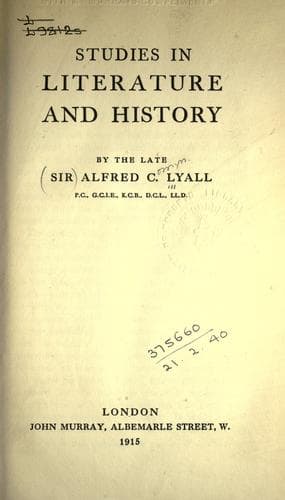
Studies in Literature and HistoryLyall, Alfred C., Sir
Religion
Studies in Literature and History
Lyall, Alfred C., Sir
English literature; History; Literature; Religion; Utilitarianism
been involved in a series of sanguinary conflicts, revolts, and costly
expeditions not unlike those which put so severe a strain upon the
Russian armies in the Caucasus. This, as we know, they did not do;
they adopted the alternative of asserting an exclusive protectorate
over the country; they were content to remain outside it so long as no
rival power was allowed to set foot in it. Yet we know that even this
much more prudent policy was carried out at a heavy cost. The British
army suffered at least one grave disaster by the total destruction of
a division in the retreat from Kabul in the winter of 1842-3. And the
Afghan War of 1878-80, with the massacre of the British envoy and his
escort at Kabul in 1879, showed us the perils and difficulties of even
a temporary and partial occupation.
At the present moment, however, the objects of our policy have been
satisfactorily fulfilled. The Russians have settled with us the
frontier line between their dominion and Afghanistan, and have bound
themselves to respect it. With the Afghan Amir we are on friendly
terms, and we have taken up our permanent position on his Eastern
border towards India, reserving to ourselves the control of the tribes
within a broad belt of territory, otherwise independent, between the
Afghan kingdom and British India. This tract is intersected by lofty
ridges running parallel for the most part to our frontier, with
precipitous slopes toward India, with a few practicable passes and
numerous gorges formed by the drainage from the watershed, enclosing
some fertile valleys along the courses of the rivers, inhabited by a
hardy population that is broken up into manifold clans and sects by
the configuration of their country. The Caucasus, as we learn from Mr.
Baddeley, 'is peopled by a greater number of different tribes and
races than any similar extent on the surface of the globe'; and it is
precisely from the same causes, difficulty of intercourse between
villages secluded in the valleys or perched on the heights, scarcity
of sustenance, inbred jealousy of each other, feuds and factions, that
the groups of the Afghan borderland dwell apart, become estranged or
hostile, are at constant war with each other, and cannot unite against
a common enemy. But while in the Caucasus this trituration of the
people has produced a multiplicity of dialects, the Afghan borderers
speak a language that is generally the same.
Public-domain text, read in full here on John Shaqi.
Reviews
Reviews
No reviews yet
Be the first to share your thoughts on this work.
Elsewhere in the archive
Join the Discussion
Join the discussion
Sign in to leave a comment or review.
Sign InorCreate an account