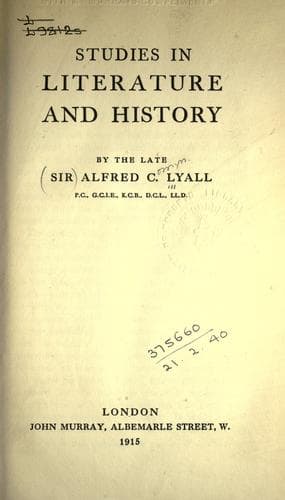
Studies in Literature and HistoryLyall, Alfred C., Sir
Religion
Studies in Literature and History
Lyall, Alfred C., Sir
English literature; History; Literature; Religion; Utilitarianism
* * * * *
It is the saying of a French writer, that the novel of to-day has
abjured both the past and the future, and lives wholly in the present.
We are so far of his opinion in regard to the past, that we doubt, for
reasons already given, whether the reading public can be induced to
travel backward into distant periods and unfamiliar scenes, even
though facts, anecdotes, costume, and other accessories be
scrupulously and historically exact. The future is a domain upon which
the novelist has rarely trespassed; but in close propinquity to it
lies theologic speculation, and we have not long ago witnessed the
fascination that can be exercised over a multitude of readers by a
novel which described the unhappiness brought upon the peaceful home
of an Anglican clergyman who was driven forth from his parsonage by
imbibing some tincture of modern Biblical criticism. The sensation,
for so it must be called, produced by _Robert Elsmere_, illustrated
the degree to which in these days popularity depends on hitting the
intellectual level of the general reader, and on touching the fancy or
the conscience of that very numerous class whose culture is of the
medium sort, neither high nor low. For while it seems certain that to
a great many people the views and arguments which overthrew Elsmere's
orthodoxy and brought him to martyrdom must have seemed profound,
daring, and novel, to others they are but too familiar and by no means
fresh. To some of us, indeed, the overpowering effect produced on
Elsmere's mind by his remarkable discoveries may be not unlike the awe
and gratitude with which an African chief receives the present of an
obsolete cannon. But the main reason why the future is no better field
than the distant past for the modern novelist, is that in both cases
there is a want of actuality, and that the positive temper of the age
requires in either case something more definite and verifiable.
It may be affirmed, moreover, as a general observation, that the
spirit of realism is hostile to the Novel with a Purpose, whether it
be that species which undertakes to argue or instruct under the cloak
of agreeable fiction, or that other species, much cultivated by
Dickens in his later works, which attacks antiquated institutions and
public abuses in a story so contrived as to expose their absurdity and
injustice. There is an air of artificiality about such compositions
which damages the artistic illusion, the photographic rendering of
actual life, upon which the author relies, because it throws over the
stage a shadow of his own personality. For one tendency of excessive
realism is to encourage an approximation between literary and
theatrical effects, since the whole interest becomes concentrated upon
figures acting and moving under a strong light in the foreground of
scenes carefully adjusted, so that anything which betrays the author's
presence interrupts the performance.
Public-domain text, read in full here on John Shaqi.
Reviews
Reviews
No reviews yet
Be the first to share your thoughts on this work.
Join the Discussion
Join the discussion
Sign in to leave a comment or review.
Sign InorCreate an account