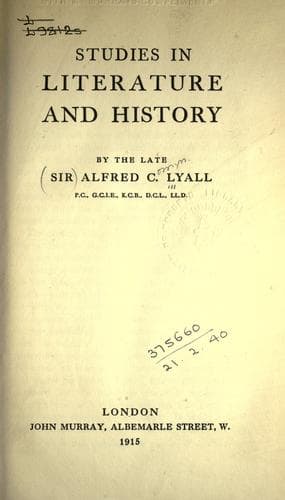
Studies in Literature and HistoryLyall, Alfred C., Sir
Religion
Studies in Literature and History
Lyall, Alfred C., Sir
English literature; History; Literature; Religion; Utilitarianism
But it may be more interesting to remind our readers that these feuds
were 'in full swing' not so very long ago in our own island. A
remarkable description of the state of the Border between England and
Scotland in the sixteenth century and earlier has recently been
published.[39] In a chapter headed 'The Deadly Feud' the author tells
us that blood-feuds set family against family and clan against clan;
and he quotes from a report submitted by Burghley to the English
Government a passage in which the term is defined thus:
'Deadly Foed, the word of enmytie on the Borders, implacable
without the blood and whole family destroyed.'
Feuds of the most bitter and hostile character, we are told, were an
everyday occurrence, and were carried on with the most ferocious
animosity on both sides. The feud was inherited along with the rest of
the family property. It was handed down from generation to generation.
The son and grandson maintained it with a bitterness which in some
cases seemed year by year to grow more intense. It affected a man's
whole social relationship, and gave rise to endless animosities and
heart-burnings.
In fact the whole description in Mr. Borland's book of the feuds
prevalent three centuries ago on our own Border might be applied to
those now actually raging among the Afghans, with the simple
alteration of time, places, and names. The comparison is worth making,
if only to show that similar conditions and circumstances produce
everywhere the same results; and that there is yet hope for the wild
Afghan, if hereafter it should be his destiny to fall under a strong
government that can enforce laws, though this is the fate which he
most dreads. No axiom is more easily refuted by historic experience
than the commonplace saying that men cannot be made moral by statutes;
the truth is that respect for a neighbour's purse or person cannot be
inculcated by any other method.
It was the political division along the Scottish Border that so long
prevented the suppression of lawlessness, and when the two kingdoms
were united it gradually ceased. On the frontier between Afghanistan
and India the British Government keeps the peace within its own
districts, but maintains only a fluctuating and ineffectual control
over the tribal territory. Yet it is manifest that no permanent
pacification can be accomplished until both sides of the line are
brought under the same firm and civilised administration. For such a
purpose it would be necessary, and would be practicable, to establish
strong posts among the turbulent highlanders, to make roads, and
probably to insist on a general disarmament, as the Russians did in
the Caucasus. But the British Government has always been reluctant to
undertake so arduous and so costly a task; though until some measure
of that kind is found possible, the intestine strife and chronic
disorder must continue; and in fact it is the natural and inevitable
solution of the problem.
Public-domain text, read in full here on John Shaqi.
Reviews
Reviews
No reviews yet
Be the first to share your thoughts on this work.
Elsewhere in the archive
Join the Discussion
Join the discussion
Sign in to leave a comment or review.
Sign InorCreate an account