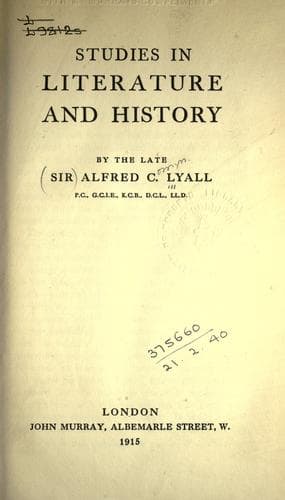
Studies in Literature and HistoryLyall, Alfred C., Sir
Religion
Studies in Literature and History
Lyall, Alfred C., Sir
English literature; History; Literature; Religion; Utilitarianism
The vendetta, or blood-feud, our author tells us, has eaten into the
very core of Afghan life. At present some of the best and noblest
families in Afghanistan are on the verge of extermination through this
wretched system. Even the women are not exempt. In a village which
the missionary visited he noticed that the houses communicated
laterally by little doors all down one long street; and on inquiry he
was told that some time before a great faction fight had been carried
on between the two rows of houses. The villagers 'were always in
ambush to fire at each other across the street. The only way to get to
the supply of water was to go from house to house to the bottom, and
in order to do this without exposure the doors had been made, while by
common consent they had agreed not to shoot while getting their
supplies from the stream.' Another anecdote relates how a British
officer visited a petty chief in his tower, and would have opened a
window to look at the country round. 'He was hurriedly and
unceremoniously pulled back by the Afghan, who told him that his
cousin had been watching that window for months in the hope of an
opportunity of shooting him there.' In fact the chief was actually
shot at this window a short time after the visit. From the universal
enmity existing between cousins in Afghanistan the proverb 'as great
an enemy as a cousin' has become a household word. 'The causes of 90
per cent. of these feuds are described by the Afghans as belonging to
one of three heads--women, money, and land; and on such matters
disputes are more likely to arise between cousins than strangers.' We
may compare Mr. Baddeley's account of an almost identical state of
things in Daghestan. It was split up (he says) 'into numerous khanates
and free communities of many different races and languages, for the
most part bitterly hostile one to another. Strife and bloodshed were
chronic between village and village, between house and house ... and
of many contributory causes none had operated so powerfully in
originating and perpetuating this state of things as the elaborate
system of blood-feud and vengeance.' And he gives one instance of a
quarrel that arose from the theft of a hen from a villager, who
retaliated by appropriating a cow. The retort was by taking a horse,
upon which the murders began.
'The blood-feud was now in full swing, and was kept up for three
centuries, during which some scores, some say hundreds, were
sacrificed in the name of honour to this terrible custom; and all
for a hen.'
Public-domain text, read in full here on John Shaqi.
Reviews
Reviews
No reviews yet
Be the first to share your thoughts on this work.
Elsewhere in the archive
Join the Discussion
Join the discussion
Sign in to leave a comment or review.
Sign InorCreate an account