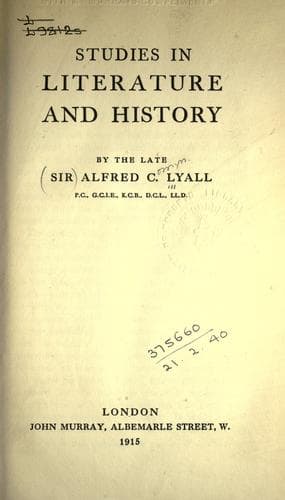
Studies in Literature and HistoryLyall, Alfred C., Sir
Religion
Studies in Literature and History
Lyall, Alfred C., Sir
English literature; History; Literature; Religion; Utilitarianism
M. Ollivier cites, in the first page of this volume, Machiavelli's
observation that mankind at large judges those who give advice in
affairs of state not by the wisdom of their counsels but by the
results. He agrees that this method is not rational, looking to the
haphazard course of human affairs, but he admits that the multitude
can judge by no other standard; and he appeals to historians for an
impartial revision of the popular verdict, founded on careful
examination of the real facts and circumstances. Yet he fears lest in
his own country the decline of patriotic enthusiasm, the cooling of
military ardour, that he notices in France at the present time, may
have rendered Frenchmen incapable of realising the hot resentment, the
intense susceptibility to affronts, the element of heroism, which were
dominant forty years ago in the national character. And he therefore
has little or no expectation that the falsehood of legends which have
been circulated regarding the events of 1870 will be proved, to his
countrymen, even by the most irrefragable demonstration. All political
parties in France, he says, have combined to hold their own ministry
responsible for that calamitous war; he despairs of obtaining from
them a hearing. He awaits with resignation the time when some
inquisitive student of history may light upon a dusty copy of his book
in the recesses of a library, and may set himself to explain how these
things actually happened to readers of the future.
The story of the decline and fall of the second French empire has
often been told; yet it may be worth while to remind English readers
of the political situation in France just forty years ago. The Emperor
Napoleon III., importuned by reformers and reactionaries, by those who
pressed him to step forward into Liberalism, and by those who insisted
that he must stand still, had at last decided upon making those
changes in the form of his government that inaugurated the Liberal
Empire; and on January 3, 1870, the new ministry took office,
supported by the goodwill of the moderate party in the Chamber of
Deputies and by the general approval of the country. M. Ollivier was
recognised as its leader and spokesman, chosen by the emperor, and
enjoying his particular confidence; though he was not prime minister
in the English constitutional sense, for the power of issuing direct
orders, and of overruling the Cabinet, was still reserved to the
sovereign; nor was he always consulted in important military or
foreign affairs. The complex and enigmatic character of Napoleon III.
is becoming gradually intelligible to the world at large, and public
opinion has lately been veering round to a less unfavourable
conclusion upon it than heretofore. He had long been reviled as a
truculent despot, artful and dangerous, powerful and perfidious; the
genius of Victor Hugo had set on him a brand of infamy. In reality, if
we may trust later French writers, there was much that was good in his
Public-domain text, read in full here on John Shaqi.
Reviews
Reviews
No reviews yet
Be the first to share your thoughts on this work.
Elsewhere in the archive
Join the Discussion
Join the discussion
Sign in to leave a comment or review.
Sign InorCreate an account