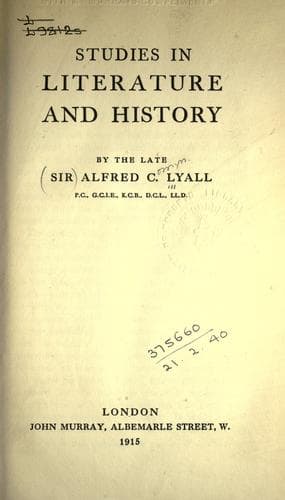
Studies in Literature and HistoryLyall, Alfred C., Sir
Religion
Studies in Literature and History
Lyall, Alfred C., Sir
English literature; History; Literature; Religion; Utilitarianism
nature, and they are disposed to regard him with compassion. M. de la
Gorce says that throughout his life Napoleon had been a humane prince.
From the entertaining memoirs of General du Barail, whose military
services brought him into frequent relations with the emperor, we
should draw the impression that the emperor was affable, considerate,
and sincerely well-intentioned. Giuseppe Pasolini, the Italian
statesman, found him simple and easy in conversation, naturally
right-minded and kindly,[42] though weak and irresolute. He was
equally capable of forming bold projects or adopting cautious
decisions; but he was apt to hesitate and turn round at the moment for
action; and it was just here that he was so unlike his uncle, Napoleon
I., who would have classed him among the _ideologues_ whom he
despised. He invented the theory of nationalities to justify his
polity of encouraging the unification of Italy, and of permitting the
aggrandisement of Germany; in the former instance he alienated the
Italians by refusing obstinately to allow them to occupy Rome; in the
latter case his neutrality when Prussia attacked Austria in 1866 was
the proximate cause of his ruin. He might have read in Machiavelli's
_Principe_ a warning of the danger of standing aside when the
neighbouring potentates come to blows. The result, it is there said,
is that the winner in such a contest becomes doubly formidable, while
the loser resents your neutral attitude, and will not help you when
the victor turns upon you with all his strength. Machiavelli declares
that this policy has always been _perniciosissimo_; and so it proved
to be in the case of the French Empire. In domestic affairs also the
Liberal Empire took up a kind of half-way position, which was assailed
by the extreme parties on both sides; for thorough-going Imperialists
like Rouher asserted that a Napoleon could only rule by retaining
absolute authority; while uncompromising Liberals demanded full
parliamentary control. Ollivier's ministry took office with the avowed
object of gradually extending constitutional administration; but he
found that, as Tocqueville had said in his _Ancien Regime_, the most
dangerous moment for an absolute government is when it endeavours to
introduce reforms.
Public-domain text, read in full here on John Shaqi.
Reviews
Reviews
No reviews yet
Be the first to share your thoughts on this work.
Elsewhere in the archive
Join the Discussion
Join the discussion
Sign in to leave a comment or review.
Sign InorCreate an account