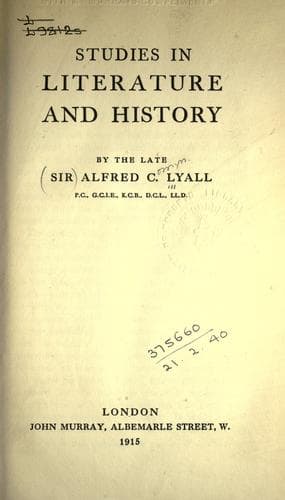
Studies in Literature and HistoryLyall, Alfred C., Sir
Religion
Studies in Literature and History
Lyall, Alfred C., Sir
English literature; History; Literature; Religion; Utilitarianism
General du Barail, in the memoirs already quoted, gives M. Ollivier
full credit for his honesty, ability, and sincere patriotism in
undertaking his difficult task, which was begun in an evil hour, and
failed through adverse circumstance. In May 1870, Ollivier, who was
holding the portfolio of Foreign Affairs, transferred it to the Duc de
Gramont, foreseeing no troubles abroad, and desiring to give his
whole attention to politics at home. The external policy of the
ministry was decidedly pacific; they relied on a quiet moment for
developing the new constitutional system; they had no notion of
changing horses in mid-stream, yet most unluckily they were caught by
a sudden flood. At the end of June it was announced in Madrid that
Leopold of Hohenzollern, son of the Roumanian prince, had accepted the
crown of Spain that had been secretly offered to him by Marshal Prim;
and the news, M. Ollivier says, startled all France like the bursting
of a bomb. It had always, we must remember, been a cardinal maxim of
French statesmanship that the maintenance of a preponderant influence
in Spain was essential to the security of France; while, on the other
hand, a complete subordination of Spanish to French interests has been
held by other governments to be dangerous to the balance of power in
Europe. The collision between these two principles had been the cause
of great wars and diplomatic quarrels. Louis XIV. only succeeded in
securing the Spanish throne for his grandson after a long war. When
Napoleon I. made his nefarious attempt to impose his brother on the
Spaniards as their king, his pretext was that under the Bourbon
dynasty Spain had always been a dependency of France; and it had been
the invariable aim of English policy to prevent a close association of
the two kingdoms. The question had long been regarded on all sides as
one of vital importance; and in 1869, when some information of secret
negotiations between Bismarck and Marshal Prim had leaked out, the
French ambassador at Berlin, Benedetti, had warned Bismarck that
France would oppose the election of a Prussian prince to the vacant
throne of Spain. Bismarck had treated the information as an improbable
rumour, yet he had carefully abstained from a formal assurance that
the king would forbid Prince Leopold to accept any such offer.[43] It
was therefore quite certain that in 1870, when the relations between
France and Prussia were in a very critical state, the announcement
that Prince Leopold had been chosen for Spain would be treated as a
most threatening move on the political chessboard. Italy was under
deep obligation to Prussia for aid in expelling the Austrians from
Venice; the St. Gothard railway had been openly promoted and
subsidised by Germany for direct and secure communication with Italy
in case of need; and now the family connection which was obviously
contemplated would bring Spain into the circle of alliances that
Bismarck was drawing round the French frontier. It was a strategical
Public-domain text, read in full here on John Shaqi.
Reviews
Reviews
No reviews yet
Be the first to share your thoughts on this work.
Elsewhere in the archive
Join the Discussion
Join the discussion
Sign in to leave a comment or review.
Sign InorCreate an account