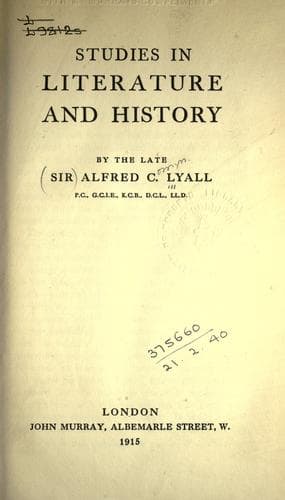
Studies in Literature and HistoryLyall, Alfred C., Sir
Religion
Studies in Literature and History
Lyall, Alfred C., Sir
English literature; History; Literature; Religion; Utilitarianism
Apparently all this stir and hurry had already affected M. Ollivier
with some misgivings; for when, on going into one of the
committee-rooms, he met Gressier, formerly a minister, he assured him
that he (Ollivier) had no intention of making the renunciation a
stepping-stone toward further demands. 'To take up that ground,'
replied Gressier, 'will be a proof of courage, but it will bring down
your ministry, for the country will never be content with this degree
of satisfaction.' M. Ollivier soon found that he was right; for a
crowd of deputies began to protest against the faint-heartedness of a
government that seemed willing to drop the whole affair, leaving
Prussia to escape scot-free; and M. Ollivier had scarcely entered the
Chamber when Clement Duvernois rose with an interpellation asking what
guarantees the Cabinet proposed to require for the purpose of
restraining Prussia from inventing more complications of this sort.
Olozaga had taken his telegram to M. de Gramont, who by no means
shared M. Ollivier's joy over it. He observed that the effect was
rather to embarrass his negotiations with Prussia, since that
government could now make the renunciation a pretext for disowning
the responsibility which he desired to fix upon the king with regard
to the whole business; and, moreover, he added, public opinion in
France will consider such a conclusion unsatisfactory. He was at that
moment engaged in colloquy with Werther, the Prussian ambassador, who
had presented himself at the Foreign Office, where presently M.
Ollivier joined them, Olozaga having departed. What followed is
treated by some French writers as the most ill-conceived of all the
false moves made by the French players in this hazardous diplomatic
game. Gramont had been urging Werther to advise the Prussian king to
write a letter to the emperor, to the effect that in authorising the
acceptance of the Spanish throne by Leopold he had no idea of giving
umbrage to France; that the king associated himself with the prince's
renunciation, and hoped that all causes of misunderstanding between
the two governments were thereby removed. Gramont sketched out what he
thought the king might say, and actually made over his note to the
Prussian ambassador, by way of _aide-memoire_; precisely as in 1867
Benedetti had trusted Bismarck with his draft of the secret treaty
proposed for the annexation of Belgium to France, which Bismarck
afterwards published in the _Times_ of July 1870. M. Ollivier, who
agreed with and supported Gramont, now maintains that his arrival
changed the character of the conference, that it ceased to be an
official interview between the Minister of Foreign Affairs and an
ambassador, and thenceforward became merely one of those free
unofficial conversations in which politicians explain their views
without compromising their respective governments. But we are obliged
to remark that in our judgment this plea is inadmissible, for M. de
Public-domain text, read in full here on John Shaqi.
Reviews
Reviews
No reviews yet
Be the first to share your thoughts on this work.
Elsewhere in the archive
Join the Discussion
Join the discussion
Sign in to leave a comment or review.
Sign InorCreate an account