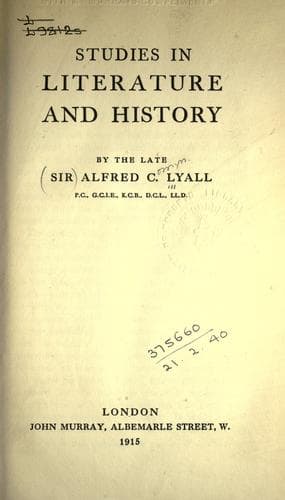
Studies in Literature and HistoryLyall, Alfred C., Sir
Religion
Studies in Literature and History
Lyall, Alfred C., Sir
English literature; History; Literature; Religion; Utilitarianism
Gramont has explicitly stated that the interview, so far as he was
concerned, was official,[47] and Werther could not have been expected
to appreciate this subtle yet important distinction--of which nothing
seems to have been said to him--while M. Ollivier should have foreseen
that Bismarck would certainly ignore it. The result was that Werther
did transmit to his king the suggestion of the two French ministers;
that the king was deeply offended at having been required to send what
he called, not unreasonably, a letter of excuses; that Bismarck used
Werther's despatch to kindle national indignation throughout Germany;
and that Werther himself was reprimanded and recalled.
The scene now shifts to St. Cloud, where the poor emperor, who had
supposed that Prince Antoine's telegram signified peace with honour,
found a military party eager for war, and hotly asserting that the
empire would be totally discredited unless satisfaction were demanded
from Prussia for conniving at the Hohenzollern candidature. The
interpellation of Duvernois in the Chamber was cited as a forcible
expression of public opinion. M. Gramont now arrived at the palace
with his report of the interview with Werther, in which the latter had
persistently declared that the king had nothing whatever to do with
Leopold's withdrawal. The emperor's unstable mind began to waver; he
forgot or put aside his arrangement with M. Ollivier--that the
ministers should meet him next morning for consultation over this new
aspect of the affair--and he proceeded then and there to hold a
Cabinet Council.
Public-domain text, read in full here on John Shaqi.
Reviews
Reviews
No reviews yet
Be the first to share your thoughts on this work.
Elsewhere in the archive
Join the Discussion
Join the discussion
Sign in to leave a comment or review.
Sign InorCreate an account