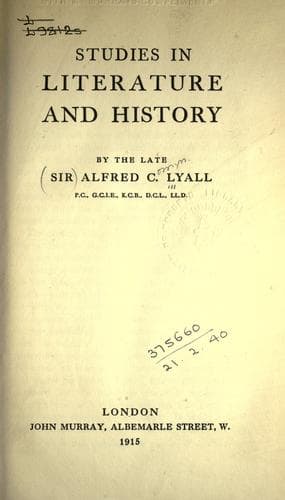
Studies in Literature and HistoryLyall, Alfred C., Sir
Religion
Studies in Literature and History
Lyall, Alfred C., Sir
English literature; History; Literature; Religion; Utilitarianism
What passed at this Council has never been exactly known. The reproach
of a ruinous blunder lies heavy on those who took part in it. Gramont
says no more than that the deliberations were conscientious, and that
every one, including the emperor, earnestly desired peace.[48] M.
Ollivier tells us, in the volume now before us, that of all the
Cabinet ministers the Duc de Gramont alone was summoned; whether he
learnt subsequently who were also present, and what share they took in
promoting the decision, he leaves his readers to guess. It is clear
that the proceeding was irregular and totally unconstitutional, and
other French writers hint that Gramont's silence is intended to shield
_une personne auguste_ from responsibility for a decision that was
fatally wrong. When the Council broke up at 7 P. M. (July 12) Gramont
immediately despatched from the Foreign Office his famous telegram to
Benedetti at Ems, instructing him to require from the Prussian king a
positive assurance that he would not authorise the renewal of
Leopold's candidature--a demand, in short, for guarantees. At his
office he met Lord Lyons, to whom he expounded his reasons for
treating the single renunciation as inadequate, to the great surprise
of our ambassador, who objected so strenuously to Gramont's views and
intentions that the minister, somewhat shaken, merely said that the
formal decision would be made public next morning. While the emperor
and two councillors were then taking irrevocable steps toward a
collision, and were unconsciously playing into the hands of their
arch-enemy, the leaders of the warlike faction in the Chamber and the
Parisian press were clamouring with fury and vitriolic sarcasm against
a faint-hearted and contemptible ministry that shrank from seizing the
opportunity of humbling Prussia.
Again the scene changes, this time to the Foreign Office, where M.
Ollivier, in total ignorance of that evening's Council at St. Cloud,
sought and found the Duc de Gramont about midnight. He had come to
ask whether any fresh news had been received from Benedetti at Ems;
and Gramont answered by showing him the telegram just despatched by
the Council's order to Benedetti, with a letter to himself from the
emperor desiring that its language should be stiffened. Naturally M.
Ollivier could hardly control his resentment at discovering that an
extremely grave resolution had been adopted and acted upon without
consulting or even warning him beforehand; that the emperor, in spite
of his promises to govern constitutionally, had reverted to such an
extreme use of autocratic power; and that Gramont had made no attempt
to check it, had even abetted the irregularity. However, the telegram
had gone to Ems--it was too late to remedy that mischief--but the
Cabinet would have to answer before the Chamber for its despatch. He
said to Gramont:
Public-domain text, read in full here on John Shaqi.
Reviews
Reviews
No reviews yet
Be the first to share your thoughts on this work.
Elsewhere in the archive
Join the Discussion
Join the discussion
Sign in to leave a comment or review.
Sign InorCreate an account