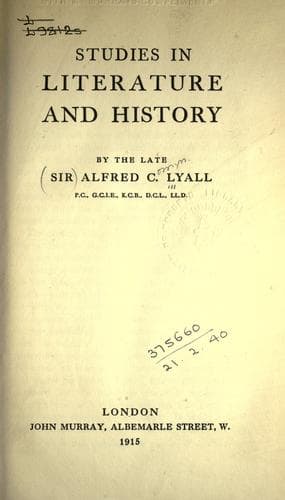
Studies in Literature and HistoryLyall, Alfred C., Sir
Religion
Studies in Literature and History
Lyall, Alfred C., Sir
English literature; History; Literature; Religion; Utilitarianism
At the Council, which was immediately summoned, Gramont threw his
portfolio on the table, saying that after what had happened a Foreign
Minister who should not vote for war would be unworthy to hold office;
and Marshal Le Boeuf informed his colleagues that they had not a
moment to lose, for Prussia was already arming. Nevertheless the
Council set themselves to a deliberate investigation of the actual
facts. Their conclusion, after six hours of discussion, was that,
according to diplomatic rule and international custom, no exception
could have been taken to the king's refusal, courteously worded, of
the interview which Benedetti had, it seemed to them, rather
pertinaciously desired; but that a reasonable refusal had been
converted into one that was offensive by its publication in terms that
were intentionally curt and stinging. Nevertheless Ollivier, clinging
to any slight chance of avoiding war, persuaded the emperor and the
Council to agree that Leopold's resignation, as approved by the
Prussian king, should be accepted by France, and that, on the further
question, whether members of a reigning family in one country could be
permitted to become kings in another, an appeal for some authoritative
ruling should be made to a general congress. But in the course of that
day the ministers received from various quarters more evidence that
Bismarck's inflammatory telegram had been sent officially to the
Prussian diplomatists at all the foreign courts; and they heard that
Paris was literally foaming with exasperation at their dilatory
indecision, while the temper of the Chamber convinced them that the
proposal for a congress would be rejected with fiery scorn. Berlin and
Paris vied with each other in turbulent patriotism and warlike fury,
and Marshal Le Boeuf, being again and for the last time questioned
by the Council, replied positively that the French army was quite
ready, and that no better opportunity of settling accounts with
Prussia could be expected. The Council rescinded its former decision,
and voted unanimously for war. The empress alone (Ollivier notes
particularly) expressed no opinion and gave no vote.
On July 15 Ollivier pronounced in the Chamber the declaration that had
been drawn up by himself and the Duc de Gramont. It was to the effect
that the Cabinet had throughout made every possible exertion to
preserve peace, but that their patience was exhausted when they found
that the King of Prussia had sent an aide-de-camp to the French
ambassador informing him that no more interviews could be granted, and
that the Prussian Government, by way of giving point and unequivocal
significance to this message, had circulated it to all other foreign
governments in Europe. Having spared no pains to avoid war, the
ministers would now accept the challenge, and prepare for the
consequences.
Public-domain text, read in full here on John Shaqi.
Reviews
Reviews
No reviews yet
Be the first to share your thoughts on this work.
Elsewhere in the archive
Join the Discussion
Join the discussion
Sign in to leave a comment or review.
Sign InorCreate an account