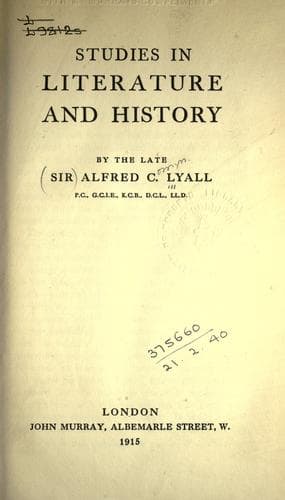
Studies in Literature and HistoryLyall, Alfred C., Sir
Religion
Studies in Literature and History
Lyall, Alfred C., Sir
English literature; History; Literature; Religion; Utilitarianism
M. Ollivier has given a vivid description of the scene that ensued.
His final words were barely audible in the storm of applause that
swept through the assembly, and the vote of urgency for the motion to
provide the necessary war-funds was demanded with enthusiastic
outcries, varied by angry vituperation of the few deputies who stood
up to oppose it. But Thiers immediately arose and, in spite of many
disorderly interruptions, made a passionate appeal to the assembly to
reflect before precipitating the country into war. His speech, with
the violent cries of dissent interjected by the war-party, is
reproduced by M. Ollivier in order, as he says, that his readers may
judge for themselves how far it merited the unstinted eulogy that has
since been bestowed upon it; for M. Ollivier evidently considers that
those who have credited Thiers with heroic patriotism in making this
strenuous effort to avert the catastrophe have over-praised him. Yet
with this view we believe that few of those who read the pages in this
volume which contain the speech will agree. They will admire, rather,
the courage and fervid eloquence of a veteran statesman who vainly
strove to persuade a frantic assembly that it was fatally misled, that
it was plunging the nation into war on a mere point of form, grasping
at a shadow after the substantial and reasonable demand for
satisfaction had been obtained by Leopold's renunciation; who reminded
the deputies that the official papers authenticating the supposed
insult had never been laid before them, and implored them not to risk
the issues of a terrible contest upon a doubtful question of national
susceptibility. M. Ollivier goes so far as to affirm that no one could
be more justly accused of having brought on the war of 1870 than
Thiers himself, because it was his vehement condemnation of the policy
which allowed Prussia to beat down Austria in 1866, and to set up a
formidable military power on the frontier of France, that inspired the
whole French people with the suspicion, jealous animosities, and alarm
which rendered a war on the Rhine between the two nations eventually
unavoidable. But Thiers in his speech emphatically repeated his
conviction that sooner or later France must fight Prussia to redress
the balance of military power between the rival countries; and the
whole point of his speech lay in one sentence: 'Je trouve l'occasion
detestablement choisie' ('Your _casus belli_ is ill chosen and utterly
indefensible'). It cannot be denied that in 1870 the public opinion of
Europe was on his side: for England and Austria, whose goodwill toward
France was unquestionable, were foremost in their efforts to deter the
French ministers from war and in deploring their infatuation when it
had been proclaimed. At St. Petersburg the Russian emperor told the
French ambassador plainly that the demand for guarantees was
unreasonable. Nor is it likely that the general judgment of the
Public-domain text, read in full here on John Shaqi.
Reviews
Reviews
No reviews yet
Be the first to share your thoughts on this work.
Elsewhere in the archive
Join the Discussion
Join the discussion
Sign in to leave a comment or review.
Sign InorCreate an account