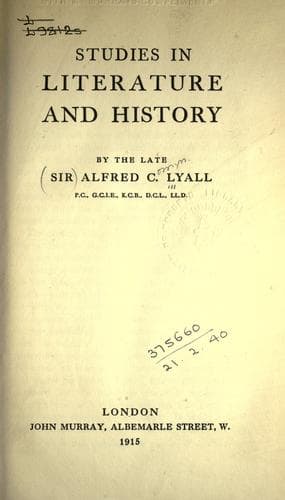
Studies in Literature and HistoryLyall, Alfred C., Sir
Religion
Studies in Literature and History
Lyall, Alfred C., Sir
English literature; History; Literature; Religion; Utilitarianism
time--that Thiers did his best to save the empire from a disastrous
blunder--will have been revoked by posterity, or affected by anything
that has since been pleaded in extenuation.
'If (said Thiers) the Hohenzollern candidature had not been withdrawn,
all France would have rallied to the support of your declaration, and
all Europe would have held you to be in the right; but it _has_ been
withdrawn with the approbation of the Prussian king, and you had
absolutely no pretext for making any further demand. What will Europe
say when you shed torrents of blood on a point of form?' M. Thiers
concluded his speech by urging the ministers to lay before the Chamber
the actual documents which, as they asserted, rendered war inevitable.
M. Ollivier, in his reply, declined to communicate certain documents
which, he said, were confidential and could not be produced without
infringement of diplomatic rules; and he laid stress on the
impossibility of tolerating the affront which had been intentionally
put upon France by Bismarck's circular telegram. And it was at the end
of this speech that he made use of the phrase which has become
historical as the typical expression of the levity and rashness with
which his ministry threw their nation into a tremendous war, insomuch
that it has become one main cause why he is so commonly charged, very
unfairly, with the whole responsibility for the blind haste that led
to the defeat and dismemberment of his country. 'Oui, de ce jour
commence pour les ministres mes collegues et pour moi, une grande
responsabilite. Nous l'acceptons le coeur leger.' The words were at
once taken up sharply and severely; and M. Ollivier went on to explain
that he meant a heart not weighted by remorse, since he and his
colleagues had done everything that was consistent with humanity and
with honour to avert a dire necessity; and since the armies of France
would be upholding a cause that was just. He now comments bitterly on
the malignity which has fastened this stigma on his name, merely
because in the heat and flurry of debate, which left him not a moment
to pick his words or arrange his sentences, he said something that he
is sure no honest man who listened to his explanation could
misconstrue into unfeeling frivolity. And in his criticism of the
speech in which M. Thiers so vehemently condemned the conduct of the
ministers he repeats emphatically that the war was not brought on by
the demand for guarantees, but by Bismarck's false and insulting
publication of the king's refusal to consider that demand. This
affront, he maintains, was insufferable. Yet we learn from his
narrative that before entering the Chamber on this eventful day M.
Ollivier had found at the Foreign Office Benedetti, just arrived from
Ems, who had already seen Bismarck's telegram in a newspaper, and
could have assured the ministers that it was a perfidious
misrepresentation, since the king had not treated him with actual
discourtesy. Nevertheless M.
Public-domain text, read in full here on John Shaqi.
Reviews
Reviews
No reviews yet
Be the first to share your thoughts on this work.
Elsewhere in the archive
Join the Discussion
Join the discussion
Sign in to leave a comment or review.
Sign InorCreate an account