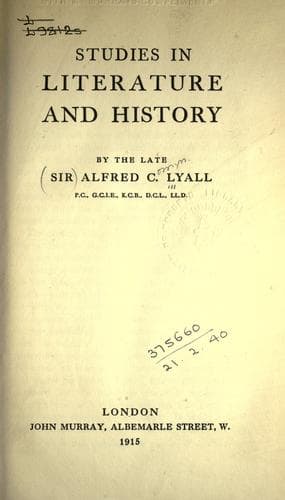
Studies in Literature and HistoryLyall, Alfred C., Sir
Religion
Studies in Literature and History
Lyall, Alfred C., Sir
English literature; History; Literature; Religion; Utilitarianism
He declares that the heroic measures introduced by legislation within
our own recollections are the links of a continuous chain extending
from a prehistoric past to an invisible future. We have here a writer
who in one chapter handles complicated statistics and economical
calculations with obvious relish, and turns from them with equal
pleasure to abstruse disquisitions on the filiation of ideas and the
march of mind.
There are at least two chapters in the History that exemplify the
attention given by Walpole to ecclesiastical controversies, and to the
significance of the antagonism between the New Learning and dogmatic
orthodoxy. In his fourth volume the story of the Oxford Tractarians is
related at some length, and he remarks on the singular coincidence,
that almost simultaneously with the secession of the English High
Churchmen the Free Church was established by disrupture from the
Established Church in Scotland. He affirms that both these schisms, so
different in motive and direction, had their origin in events dating
from the sixteenth and seventeenth centuries. The disintegrating
forces of geology, astronomy, and scientific research generally upon
the received tradition are examined; the beginning of modern Church
reform is noted; and in a chapter of the final volume of the _History
of Twenty-five Years_ it is maintained that the great question before
the religious world in the middle of the nineteenth century was the
possibility of resisting the inroads of science. He describes the
vigour with which the polemical campaign was conducted on both sides;
how the orthodox position was assailed by writers of the _Essays and
Reviews_, by the criticism of Bishop Colenso, by Broad Churchmen and
the champions of free thought; how it was defended by prosecutions in
the ecclesiastical courts and in appeals to the Privy Council from
both parties. It was certainly a remarkable epoch in the history of
opinions, when the country was agitated by the ardent zeal of
disputants over questions of ritual and dogma that now seem to have
fallen into cool neglect; and Walpole gives, as usual, a careful array
of the particular cases, with the points in debate, and the
characteristics of the prominent leaders in each party. To estimate
the position of the clergy as a body, and to show, as Walpole
undertakes to do, that in the middle of the nineteenth century they
were losing caste as a class, and that between the middle and end of
that century they had fallen in social status, was a much more
difficult and delicate problem. All generalisations upon the condition
of society in times that have passed away, however recently, are of
doubtful value, because the evidence of documents must always be
incomplete, and even personal recollections are partial and become
indistinct; they are all seen in a fading and uncertain light.
Moreover the chronicler of disputations over ritual and articles, and
of matters concerning churches and the clergy, may be said to move
Public-domain text, read in full here on John Shaqi.
Reviews
Reviews
No reviews yet
Be the first to share your thoughts on this work.
Elsewhere in the archive
Join the Discussion
Join the discussion
Sign in to leave a comment or review.
Sign InorCreate an account