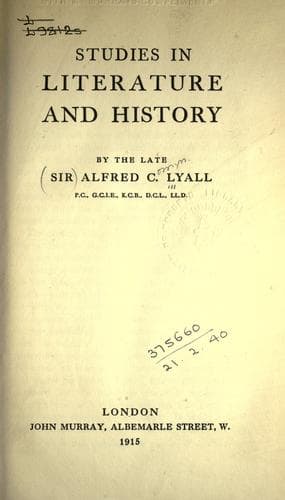
Studies in Literature and HistoryLyall, Alfred C., Sir
Religion
Studies in Literature and History
Lyall, Alfred C., Sir
English literature; History; Literature; Religion; Utilitarianism
over the surface of the spiritual waters; and Walpole draws nearer to
the deeper undercurrents when he appeals to the higher literature for
signs of alternating tendencies of religious thought in that
generation; though the famous stanzas from Tennyson's 'In Memoriam,'
which he quotes at the end of his chapter, represent rather the poetic
than the philosophic conclusions of thinkers in the nineteenth
century.
But Walpole was quite aware of the difficulties that beset any writer
who endeavours to relate the history of a very recent period,
especially of that part to which his own lifetime belongs, and to pass
judgments on the conduct or opinions of statesmen and writers who may
be still living, or have only lately departed. Yet, as Lord Acton has
said, the secrets of our own time cannot be learnt from books, but
from men; and Walpole's social relations, his personal popularity, his
familiarity with official business, and his literary culture, provided
him with valuable opportunities for composing his last four volumes
from direct impressions of his subject, for preserving the right
atmosphere. His studies in biography show an aptitude for personal
delineation; and in one of his earlier volumes there is a full-length
portrait of Sir Robert Peel, executed with much skill and
comprehension. Therein lay the artistic quality of his work; he aimed
at the presentation of individual character and action; he laid stress
on the influence of remarkable men on their country's fortunes; for
true historical art is concerned with bringing prominent figures into
formal relief, and with arranging a mass of disorderly facts under
some scheme that produces a definite impression. Otherwise Walpole's
style was clear, level, and straightforward; with no pretence to be
ornamental. Perhaps the best example of his talent for well-ordered
and compact narrative is found in two chapters of the fifth volume of
the History, which contain an excellent summary of the rise and
expansion of British dominion in India during the eighteenth and
nineteenth centuries, with a very correct appreciation of the causes
and circumstances to which that memorable episode in the annals of the
British Empire is due.
Public-domain text, read in full here on John Shaqi.
Reviews
Reviews
No reviews yet
Be the first to share your thoughts on this work.
Elsewhere in the archive
Join the Discussion
Join the discussion
Sign in to leave a comment or review.
Sign InorCreate an account