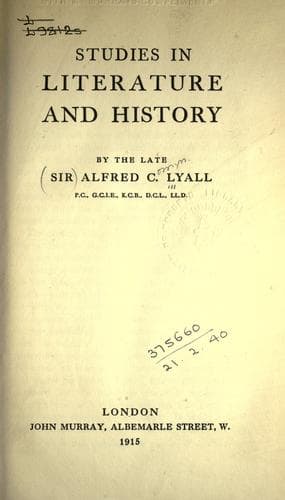
Studies in Literature and HistoryLyall, Alfred C., Sir
Religion
Studies in Literature and History
Lyall, Alfred C., Sir
English literature; History; Literature; Religion; Utilitarianism
Now my next observation is that, although the science of history has
since been invented, we have, among quite modern English writers, men
of singular genius, who have to some extent followed the example,
adopted the manner, of the ancient annalist. Like him, they are
artists, their aim has been to depict famous men, to reproduce
striking incidents and scenes dramatically. Their technical methods,
so to speak, are entirely different from those of the old chronicler,
who sketched with a free hand, and trusted largely to his
inspirations, to his own experience of what was likely to have been
said or done, or to popular tradition, which is always animated and
distinct. The modern historian, of what I may call the school of
impressionists, has no such experience, he knows nothing personally of
violent scenes or fierce deeds; he composes his picture of things that
happened long ago from a mass of papers, books, memoirs, that have
come down to us. Yet although style and substance are quite different,
the chief aim, the design, of the ancient and modern artist in
history is the same. They both strive to set before their reader a
vision of certain scenes and figures at moments of energetic
action--not only to tell him a story, but to make him see it. Let me
give an example. Every one here may remember the story in the Old
Testament (2nd Book of Kings) of Jehu driving furiously into Jezreel,
how on his way he smote Ahaziah, king of Judah, with an arrow, and how
Jezebel, the Phoenician Queen, was hurled down out of her palace
window to be devoured by dogs in the street. And some of you may have
read in Froude's _History of the Reign of Queen Elizabeth_ his
description of the murder of David Rizzio by the fierce Scotch nobles,
how he was killed clinging to Queen Mary's knees in her chamber in
Holyrood Palace. Now the manner, the artistic presentation of
ferocious action, are in both cases alike; we have the words spoken
and the deeds done; we can look on at the bloody tragedy; we have a
dramatic version of the story. The ancient writer of the Old Testament
probably did his work naturally, instinctively; he tells the story as
he received it by word of mouth, briefly--laying stress only on the
things that cut into the imagination of an eye-witness, and remain in
the memory of those to whom they were related. He troubles us with no
moral reflections, but goes on quietly to the next chapter of
incidents. The modern historian has composed his picture from details
collected by study of documents; he puts in adjectives as a painter
lays on colour; yet the effect, the impression, is of the same
quality: it is artistic.
Public-domain text, read in full here on John Shaqi.
Reviews
Reviews
No reviews yet
Be the first to share your thoughts on this work.
Elsewhere in the archive
Join the Discussion
Join the discussion
Sign in to leave a comment or review.
Sign InorCreate an account