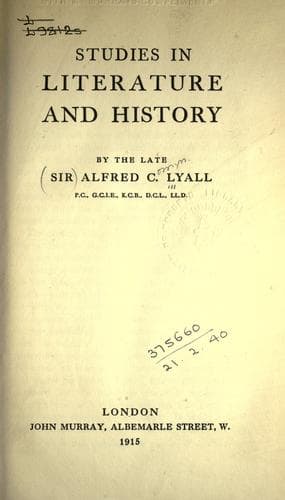
Studies in Literature and HistoryLyall, Alfred C., Sir
Religion
Studies in Literature and History
Lyall, Alfred C., Sir
English literature; History; Literature; Religion; Utilitarianism
The correspondence of our own generation has been written under a
different intellectual climate, and various circumstances have
combined to lower the temperature of its vivacity. Posthumous
publicity is now the manifest destiny that overhangs the private life
of all notable persons, especially of popular authors, who can observe
and inwardly digest continual warnings of the treatment which they are
likely to receive from an insatiable and inconsistent criticism. They
may have lived long and altered their opinions; they may have
quarrelled with friends or rivals, and may have become sworn allies
later; they may have publicly praised one whom in private they may
have laughed at; for when you have to think what you say, it does not
follow that you say what you think. All these considerations, enforced
by repeated examples, are apt to damp the natural ardour of
improvisation; the more so because the writer may be sure either that
his genuine utterances will be suppressed by the editor, or that, if
they are produced, the editor will be roundly abused for giving him
away. For in these matters the judgment of the general reader is
wayward, and his attitude undecided, with a leaning toward hypocrisy.
The story of the domestic tribulations and the conjugal bickerings of
a great writer, of the irritability that belongs to highly nervous
temperaments, and which has always made genius, like the finest
animals, hard to domesticate, has lost none of its savour with the
public. But if all letters that record such scenes and sayings are
faithfully reproduced in preparing the votive tablet upon which the
dead man's life is to be delineated, the ungrateful reader answers
with an accusation of imprudence, indiscretion, and betrayal of
confidence; and the surviving friends protest still more vehemently.
Within the last three months these consequences have been forcibly
illustrated by the reception of Cardinal Manning's Life, in which the
letters are of extraordinary value toward the formation of a right
understanding of that remarkable personage. Much of all this
sensitiveness is clearly due to the hasty fashion of publishing
private correspondence within a few years of the writer's decease, but
more to the fitful and somewhat feminine temper of an inquisitive yet
censorious society.
Public-domain text, read in full here on John Shaqi.
Reviews
Reviews
No reviews yet
Be the first to share your thoughts on this work.
Join the Discussion
Join the discussion
Sign in to leave a comment or review.
Sign InorCreate an account