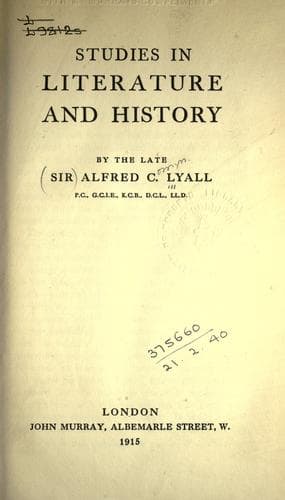
Studies in Literature and HistoryLyall, Alfred C., Sir
Religion
Studies in Literature and History
Lyall, Alfred C., Sir
English literature; History; Literature; Religion; Utilitarianism
'I think it is true,' he writes to Jowett (1849), 'that we have not
the same mental interest in talking over subjects of theology that
we had formerly. They have lost their novelty, I suppose; we know
better where we are, having rolled to the bottom together, and
being now able only to make a few uphill steps. I acknowledge fully
my own want of freshness; my mind seems at times quite dried up....
And at times I have felt an unsatisfied desire after a better and
higher sort of life, which makes me impatient of the details of
theology.'
In these, and perhaps one or two other passages, we can trace the
development of character and convictions in the man to whom Jowett
wrote, thirty years afterwards, that he was 'the most distinguished
clergyman in the Church of England, who could do more than any one
towards the great work of placing religion on a rational basis.'[9]
But, on the whole, the quality of these letters is by no means equal
to their quantity; and too many of them belong to a class which,
though it may have some ephemeral interest among friends and kinsfolk,
can retain, we submit, no permanent value at all. It is best described
under a title common in French literature--_impressions de voyage_. A
very large part of the volume consists of letters written by Stanley,
an intelligent and indefatigable tourist, from the countries and
cities which he visited, from Petersburg and Palestine, from Paris and
Athens, from Spain and Scotland. The standpoint from which he surveys
the Holy Land is rather historical and archaeological than devotional;
but he had everywhere a clear eye for the picturesque in manners and
scenery. He had excellent opportunities of seeing the places and the
people; his descriptive powers are considerable; and there is a finely
drawn picture of All Souls' Day in the Sistine Chapel, written from
Rome to Hugh Pearson, although a ludicrous incident comes in at the
end like a false note. Such correspondence might be so arranged
separately as to make an interesting narrative of travel, but when
judged by a high literary or intellectual criterion of letter-writing
it is out of court. It is not too much to aver that most, if not all,
of these letters might have been written by any refined and cultivated
Englishman, whose education and social training had given him correct
tastes and a many-sided interest in the world. They belong to the type
of private diary or chronicle, and as such they inevitably include
trivialities, though not many. Some of Stanley's letters are from
Scotland, where he travels about admiring its wildness, and with a
cultured interest in its antiquities. But no country has been better
ransacked in search of the picturesque; it is the original
hunting-ground of the romantic tourist, and what Stanley said about it
to his family is pleasantly but not powerfully written. It is more
than doubtful whether excellence in letter-writing lies that way, or,
Public-domain text, read in full here on John Shaqi.
Reviews
Reviews
No reviews yet
Be the first to share your thoughts on this work.
Join the Discussion
Join the discussion
Sign in to leave a comment or review.
Sign InorCreate an account