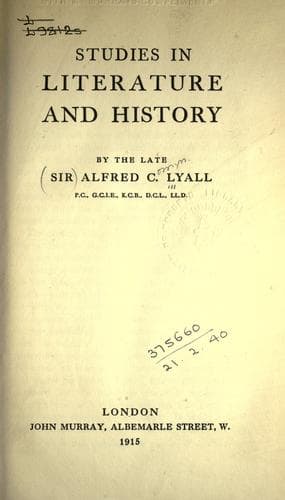
Studies in Literature and HistoryLyall, Alfred C., Sir
Religion
Studies in Literature and History
Lyall, Alfred C., Sir
English literature; History; Literature; Religion; Utilitarianism
'The world contains scores of such amiable people, and, indeed, it
is because justice has not been done them that we have edited this
autobiography. Had it been that of a mere hero of romance--one of
those heroic youths who figure in the novels of Scott or James,
there would have been no call to introduce the reader to a
personage already so often and so charmingly depicted. Mr. Barry is
not, we repeat, a hero of the common pattern; but let the reader
look round and ask himself, "Do not as many rogues succeed in life
as honest men, more fools than men of talent?" And is it not just
that the lives of this class should be described by the students of
human nature as well as the actions of those fairy-tale princes,
those perfectly impossible heroes,' etc., etc.
One would be almost inclined to infer from this passage that the
author had identified himself so completely with his own creation as
to have become slightly infected with Mr. Barry Lyndon's sophistry;
for it is impossible to maintain seriously that rogues and fools are
no less successful in life than men of honesty and talent. But the
truth is that Thackeray found in a daring rogue a much finer subject
for character-drawing than in the blameless hero, while he was deeply
implicated in the formidable revolt which Carlyle was leading against
the respectabilities of that day.
It is worth notice that in Barry Lyndon's military reminiscences, done
with great vigour and fidelity of detail, we have a very early example
of the realistic as contrasted with the romantic treatment of
campaigns, of life in the bivouac and the barrack. This method, which
has latterly had immense vogue, seems to have been first invented in
France, where Thackeray may have taken the hint from Stendhal; but we
are disposed to believe that he was the first who proclaimed it in
England. As it professes to give the true unvarnished aspect of war it
would certainly have accorded with Thackeray's natural contempt, so
often shown in his writings, for the commonplaces of the military
romancer who revelled in the pomp and circumstance of glorious
battles, the charges, the heroic exploits, the honours, rather than
the horrors, of the fighting business. Moreover, it is not only in
style and treatment but also in sentiment and in certain peculiar
prepossessions, that we can trace in this novel the lines which the
writer followed throughout his narratives, and his favourite
delineations of character. For diplomatists he has always a curious
contempt, and he never misses an opportunity of ridiculing them. 'Mon
Dieu,' says Lyndon, 'what fools they are; what dullards, what
fribbles, what addle-headed coxcombs; this is one of the lies of the
world, this diplomacy'--as if it were not also a most important and
difficult branch of the national services. Abject reverence of great
folk he regarded as the besetting disease of middle-class Englishmen;
Public-domain text, read in full here on John Shaqi.
Reviews
Reviews
No reviews yet
Be the first to share your thoughts on this work.
Elsewhere in the archive
Join the Discussion
Join the discussion
Sign in to leave a comment or review.
Sign InorCreate an account