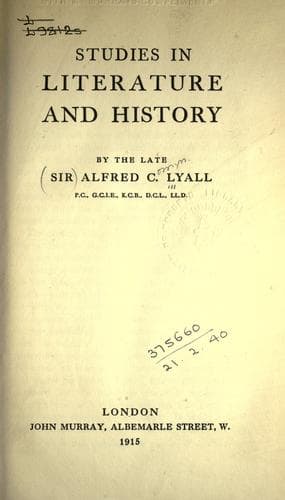
Studies in Literature and HistoryLyall, Alfred C., Sir
Religion
Studies in Literature and History
Lyall, Alfred C., Sir
English literature; History; Literature; Religion; Utilitarianism
and so we find Lyndon remarking, by the way, that Mr. Hunt, Lord
Bullingdon's governor, 'being a college tutor and an Englishman, was
ready to go on his knees to any one who resembled a man of fashion.'
And the kindly cynicism which discoloured Thackeray's ideas about
women, notwithstanding his tender admiration and love for the best of
them, comes out pointedly in old Sir Charles Lyndon's advice to Barry
on the subject of matrimony:
'Get a friend, sir, and that friend a woman, a good household
drudge, who loves you. _That_ is the most precious sort of
friendship, for the expense of it is all on the woman's side. The
man need not contribute anything. If he's a rogue, she'll vow he's
an angel; if he's a brute, she will like him all the better for his
ill-treatment of her. They like it, sir, these women; they are born
to be our greatest comforts and conveniences, our moral boot-jacks,
as it were.'
Barry Lyndon discloses the promise and potency of Thackeray's genius.
In _Vanity Fair_, his next work, it has attained its climax; the
dramatic figures are more finely conceived, the plot is varied and
more skilfully elaborated, the actors more numerous and life-like; and
whereas in his preceding stories he has mainly used the form of a
fictitious memoir, whereby the hero is made to tell his own tale, in
this 'Novel without a Hero' the author proceeds by narration. The tone
is still governed by irony and pathos, wherein Thackeray chiefly
excels; yet the contrasts between weak and strong natures, the
superiority of honesty and the moral sense over craftiness and
unscrupulous cleverness, are now touched off with a lighter and surer
hand. The unmitigated villain and the coarse-tongued hard-hearted
virago have disappeared with other primitive stage properties; the
human comedy is played by men and women of the upper world, with their
virtues and frailties sufficiently set in relief, yet not exaggerated,
for the purposes of the social drama. The book's very title, _Vanity
Fair_, denotes a transition from the scathing satire of his earlier
manner to more indulgent irony, from Swift to Sterne, two authors whom
Thackeray had evidently studied attentively. In his short preface the
author preludes with the gentler note when he invites people of a
lazy, benevolent, or sarcastic mood to step into the puppet show for a
moment and look at the performance.
Public-domain text, read in full here on John Shaqi.
Reviews
Reviews
No reviews yet
Be the first to share your thoughts on this work.
Elsewhere in the archive
Join the Discussion
Join the discussion
Sign in to leave a comment or review.
Sign InorCreate an account