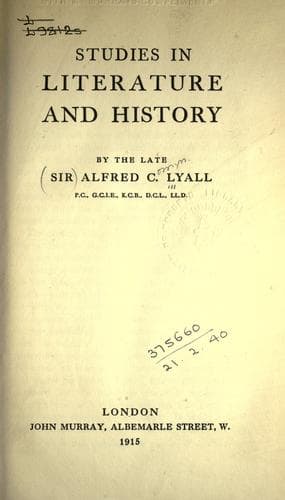
Studies in Literature and HistoryLyall, Alfred C., Sir
Religion
Studies in Literature and History
Lyall, Alfred C., Sir
English literature; History; Literature; Religion; Utilitarianism
The book's success, Mrs. Ritchie tells us, was slow; the sale hung
fire. 'One has heard of the journeys which the manuscript made to
various publishers' houses before it could find any one ready to
undertake the venture, and how long its appearance was delayed by
various doubts and hesitations, until it was at last brought out in
its yellow covers by Messrs. Bradbury and Evans on January 1, 1847.'
But when the last numbers were appearing Thackeray wrote that,
'although it does everything but sell, it appears really to increase
my reputation immensely'--as it assuredly did. That a signal success
in literature is nearly always achieved, not by following the beaten
road, but by a bold departure from it, is a principle that could be
abundantly established by examples, and which seems almost a truism
when it is stated. _Vanity Fair_ was decidedly a work of great
freshness and originality; but publishers are circumspect and rarely
adventurous, they distrust novelties and prefer to follow the
prevailing fashion as far as it will go, wherein we may discern one
reason why the accouchement of the first literary child is usually so
laborious.
To criticise at length any single novel of Thackeray's would be far
beyond the scope or purpose of this article. Our object is rather to
illustrate the course and development of his distinctive literary
qualities, the slow effacement of prejudices which never entirely
disappeared, and the rapid expansion of his highest artistic
faculties. To begin with the prejudices. In _Vanity Fair_ he still
makes merciless war upon the poor paltry snob, whom one must suppose
to have infested English society of that day in a very rampant form;
though unless we have had great changes for the better in the last
fifty years, one might suspect exaggeration. And another important
reform of manners must have supervened in the same period if we are to
believe that in these novels the English servant is not unfairly
caricatured. As we know him at the present day, in the class that
lives with gentle-folk, he may be touchy and troublesome, with much
self-assertiveness, but also with much self-respect. He has as many
faults as other people, but among them brutal rudeness is practically
unknown; yet when Rebecca Sharp is driven in Mr. Sedley's carriage to
Sir Pitt Crawley's, having given nothing to the domestics on leaving
the Sedleys, the coachman is ludicrously rude to a poor governess.
'"I shall write to Mr. Sedley, and inform him of your conduct,"
said Miss Sharp to him.
'"Don't," replied that functionary; "I hope you've forgot nothink?
Miss 'Melia's gownds--have you got them--as the lady's maid was to
have 'ad? I hope they'll fit you. Shut the door, Jim, you'll get no
good out of _'er_," continued John, pointing with his thumb towards
Miss Sharp; "a bad lot, I tell you, a bad lot."'
Public-domain text, read in full here on John Shaqi.
Reviews
Reviews
No reviews yet
Be the first to share your thoughts on this work.
Elsewhere in the archive
Join the Discussion
Join the discussion
Sign in to leave a comment or review.
Sign InorCreate an account