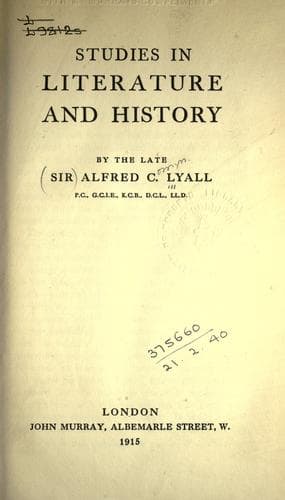
Studies in Literature and HistoryLyall, Alfred C., Sir
Religion
Studies in Literature and History
Lyall, Alfred C., Sir
English literature; History; Literature; Religion; Utilitarianism
We must, therefore, place _The Virginians_ below _Esmond_ in the order
of merit. Nevertheless, these two novels, with _Barry Lyndon_, are
most important and valuable contributions to the English historical
series. Nothing like them had been written before, and nothing equal
has been written after them, with the single exception of _John
Inglesant_. They possess one essential quality that ought to
distinguish all fiction founded on the history of bygone times--they
are, so far as posterity can judge at all, faithful and effective
representations of manners. Now, the inferior practitioner in this
particular school, being prevented by indolence or incapacity from
mastering his period and acquiring insight into its ways of thought
and living, is too often content to cover up his deficiencies by
indenting freely on the theatrical wardrobe and armoury. He deals
largely in the costumes of the day; he supplies himself plentifully
with old-fashioned phrases; he is fond of old furniture; he is
strongest, in fact, upon the external and decorative aspect of the
society to which he introduces us. Most of the romances written in
imitation of Scott had this tendency; and this same feebleness
underlies the superfluous minuteness of detail that may be observed in
the decadent realists of the present day. Nothing of this sort can be
alleged against Thackeray, who works from inward outwardly in his
creations of character, and whose personages are truly historical in
the sense that they move and speak naturally according to the ideas
and circumstances of their age, the dialect and dress being merely
added as appropriate colouring. It is, indeed, a peculiarity of
Thackeray's novels, which distinguishes him alike from the romancer
and the modern naturalist that they contain hardly any description,
that he is never professedly picturesque, that he relies entirely on
passing strokes and effective details given by the way. In Scott we
have superb descriptive pieces of scenery, of storms, of the interiors
of a castle or a Gothic cathedral; and some of the best living
novelists are much given to elaborate landscape painting. But we doubt
whether half a page of deliberately picturesque description can be
found in any of Thackeray's first-class works. He will sometimes
sketch off the inside of a house or the look of a town, but with
natural scenery he does not concern himself; he is, for the most part,
entirely occupied with the analysis of character, or with the
emotional side of life; and he seems constantly to bear in mind the
Aristotelian maxim that life consists in action. His principal
instrument for the exhibition of motive, for the evolution of his
story, for bringing out qualities, is dialogue, which he manages with
great dexterity and effect, giving it point and raciness, and
avoiding the snare--into which recent social novelists have been
falling--of insignificance and prolixity. The method of easy,
Public-domain text, read in full here on John Shaqi.
Reviews
Reviews
No reviews yet
Be the first to share your thoughts on this work.
Elsewhere in the archive
Join the Discussion
Join the discussion
Sign in to leave a comment or review.
Sign InorCreate an account