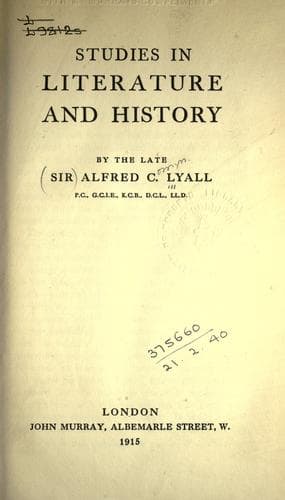
Studies in Literature and HistoryLyall, Alfred C., Sir
Religion
Studies in Literature and History
Lyall, Alfred C., Sir
English literature; History; Literature; Religion; Utilitarianism
sparkling, natural dialogue for developing the plot and distinguishing
the personages is said to have been first transferred from the theatre
to the novel by Walter Scott. At any rate, the use of it on a large
scale, which has since been carried to the verge of abuse, began with
the Waverley novels; where we find abundance of that humorous
vernacular talk in which Shakespeare excelled, though for the romance
Cervantes may be registered as its inventor. In Thackeray's hands
dramatic conversation, as of actors on the stage, becomes of very
prominent importance, not only for the illustration of manners in
society, but also for dressing up the subordinate figures of his
company. He is now no longer the caricaturist of earlier days; he
employs the popular dialect and comic touches with effective
moderation. And he avails himself very freely, in _The Virginians_, of
the privilege which belongs to the historical novelist, who is allowed
to make the reader acquainted with the notabilities of the period not
only for the movement of his drama, but also for a passing glance or
casual introduction, as might happen in any place of public resort or
in a crowded _salon_. Franklin, Johnson, and Richardson, George Selwyn
and Lord Chesterfield, cross the stage and disappear, after a few
remarks of their own or the author's. For military officers, who
figure in all his novels, he has ever a kindly word; and also for
sailors, although it is only in his last (unfinished) novel that he
takes up the navy. For English clergymen, especially for bishops, he
has no indulgence at all; and he seems to be possessed by the
commonplace error of believing that the prevailing types of the
Anglican Church in the eighteenth century were the courtier-bishop
and the humble obsequious chaplain. The typical Irishman of fiction,
with his mixture of recklessness and cunning, warm-hearted and
unveracious, is to be found, we think, in every one of Thackeray's
larger novels, except in _The Virginians_; the Scotsman is rare,
having been considerably used up by Walter Scott and his assiduous
imitators. We may notice (parenthetically) that our own day is
witnessing a marvellous revival of Highlanders and Lowlanders in
fiction, from Jacobite adventures to the pawky wit and humble
incidents of the kailyard.
Public-domain text, read in full here on John Shaqi.
Reviews
Reviews
No reviews yet
Be the first to share your thoughts on this work.
Elsewhere in the archive
Join the Discussion
Join the discussion
Sign in to leave a comment or review.
Sign InorCreate an account