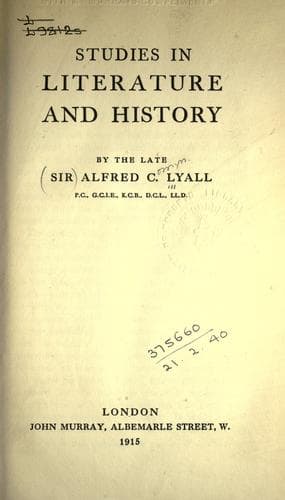
Studies in Literature and HistoryLyall, Alfred C., Sir
Religion
Studies in Literature and History
Lyall, Alfred C., Sir
English literature; History; Literature; Religion; Utilitarianism
The Notes which appeared in the _Cornhill Magazine_, June 1864, as an
epilogue to the last lines written by Thackeray, when the story
stopped abruptly, throw curious light on the methods of gathering his
material and preparing his work. Just as he visited the Blenheim
battlefield, when he was engaged upon _Esmond_, so he went down to
Romney Marsh, where Denis Duval was born and bred, surveyed Rye and
Winchelsea as if he were drawing plans of those towns, and collected
local traditions of the coast and the country, of the smugglers, the
Huguenot settlements, and the old war time of 1778-82. The _Annual
Register_ and the _Gentleman's Magazine_ furnished him with suggestive
incidents and circumstantial reports which he expanded with admirable
fertility of imagination; so that by combining what he saw with what
he read he could lift the curtain and light up again an obscure corner
of the Kentish coast, and the doings of the queer folk who lived on it
a century before he went there. That he never finished this novel is
much to be lamented, for Denis had just become a midshipman on board
the _Serapis_, and we learn from these 'Notes' that he was to take
part in the great fight which ended in the capture of that ship by
Paul Jones, after the most bloody and desperate duel in the long and
glorious record of the British Navy. Captain Pearson, who commanded
the _Serapis_, reported his defeat to the Admiralty in a letter of
which 'Mr. Thackeray seems to have thought much,' and, indeed, it is
precisely the sort of document--quiet, formal, with a masculine
contempt for adjectives (there is not one in the whole letter)--which
denotes a character after Thackeray's own heart.
'We dropt alongside of each other, head and stern, when, the fluke
of our spare anchor hooking his quarter, we became so close, fore
and aft, that the muzzles of our guns touched each other's sides.'
Here we have the style which Thackeray loved; and 'tis pity that we
have so narrowly missed the picture of a fierce naval battle by an
artist who could describe strenuous action in steady phrase, and who
knew that the hard-fighting commander is usually a cool, resolute,
resourceful man, for whom it is a matter of plain duty to fight his
ship till he is fairly beaten, and to report the result briefly,
whatever it may be, to his superiors. One can observe the mellowing
influence upon Thackeray of the atmosphere of past times and the
afterglow of heroic deeds; for in _Denis Duval_ there is no trace of
the scorching satire which pursues us in _The Newcomes_; nor does he
once pause to moralise, or to enlarge upon the innumerable hypocrisies
of modern society. It is questionable, indeed, whether this fine
fragment binds up well in a volume with the _Roundabout Papers_, which
bring the author back into the light of common day, and to the
trivialities of ordinary society.
Public-domain text, read in full here on John Shaqi.
Reviews
Reviews
No reviews yet
Be the first to share your thoughts on this work.
Elsewhere in the archive
Join the Discussion
Join the discussion
Sign in to leave a comment or review.
Sign InorCreate an account