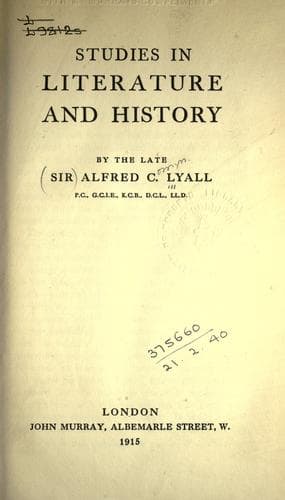
Studies in Literature and HistoryLyall, Alfred C., Sir
Religion
Studies in Literature and History
Lyall, Alfred C., Sir
English literature; History; Literature; Religion; Utilitarianism
It has not been thought necessary, in this biographical edition, to
issue the several volumes in the order of the dates at which they were
written; nor has the attempt been made to preserve some serial
continuity of their style or subject. The arrangement, moreover,
serves to accentuate unnecessarily the undeniable imparity of
Thackeray's different books; for _Punch_ and the _Sketch Books_ are
interposed between _Barry Lyndon_ and _Esmond_; while even the wild
and wicked Lyndon hardly deserved to be handcuffed in the same volume
with Fitzboodle, whom in the body he would have crushed like an
insect. Yet the classification of Thackeray's novels might be easily
made, for _Barry Lyndon_, _Esmond_, _The Virginians_, and _Denis
Duval_ fall together in one homogeneous group, having a strong family
resemblance in tone and treatment, and following generally the
chronological succession of the periods with which they are concerned.
If to Esmond is awarded the precedence that is due to him not by
seniority, but by importance, we have the wars of the eighteenth
century between England and France from Marlborough's campaigns down
to Rodney's great naval victory of 1783, in which Duval was destined
to take part. These works represent Thackeray's very considerable
contribution to the Historic School of English novelists; and we may
count them also a valuable commentary upon English history, for
without doubt every luminous illustration of past times and personages
acts as a powerful stimulant to the national mind, by exciting a
keener interest in the nation's story and a clearer appreciation of
its reality. Chateaubriand has affirmed that Walter Scott's romances
produced a revolution in the art of writing histories, that no greater
master of the art of historical divination has ever lived, and that
his profound insight into the mediaeval world, its names, the true
relation between different classes, its political and social aspects,
originated a new and brilliant historical method which superseded the
dim and limited views of scholarly erudition. For Thackeray we make no
such extensive or extravagant claims; but it may be said that the
dramatic conception of history in his novels and lectures was of
great service to his readers and hearers by the vivid impressions
which they conveyed of the life, character, and feelings of their
forefathers, of their failings, virtues, and memorable achievements.
Some material objections may be taken to the system of teaching by
graphic pictures in Thackeray, as in Carlyle's _French Revolution_,
and in both cases the philosophy leaves much to be desired, for the
writer's own idiosyncrasy colours all his work. Yet when we remember
how few are the readers to whom the accurate Dryasdust, with his
careful research and well attested facts, brings any lasting
enlightenment, we may well believe that very many owe their distinct
ideas of the state of England and its people during the last century
Public-domain text, read in full here on John Shaqi.
Reviews
Reviews
No reviews yet
Be the first to share your thoughts on this work.
Elsewhere in the archive
Join the Discussion
Join the discussion
Sign in to leave a comment or review.
Sign InorCreate an account