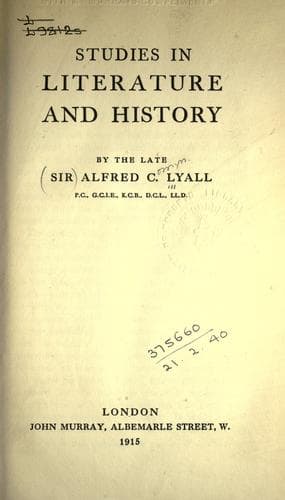
Studies in Literature and HistoryLyall, Alfred C., Sir
Religion
Studies in Literature and History
Lyall, Alfred C., Sir
English literature; History; Literature; Religion; Utilitarianism
to Thackeray's genius for carefully studied autobiographical fiction.
To the four historical novels mentioned above let us add three novels
of nineteenth-century manners--_Vanity Fair_, _Pendennis_, _The
Newcomes_--and we have seven books (one incomplete) upon which
Thackeray's name and fame survive, and will be handed down to
posterity. The list is by no means long if it be compared with the
outturn of Scott and Bulwer-Lytton, or of his foremost contemporary
Dickens; and Stevenson, who resembles him in the subdued realistic
style of narrating a perilous fight or adventure, has left us a larger
bequest. But they are amply sufficient to build up for him a lasting
monument in English literature; and their very paucity may serve as a
warning against the prevailing sin of copious and indiscriminate
productiveness, by which so many second-rate novelists of the present
day exhaust their powers and drown a respectable reputation in a flood
of writing, which sinks in quality in proportion to the rise in
quantity.
How far the character and personal experiences of an author are
revealed or disguised in his writings is a question which has often
been discussed. Bulwer once endeavoured, in a whimsical essay, to
prove that men of letters are the only people whose characters are
really ascertainable, because you may know them intimately by their
works; but herein he merely touched upon the general truth or truism
that society at large judges every man only by his public
performances, and does not trouble itself at all about anything else.
In the category of those who display in their writings their tastes
and prejudices, their feelings and the special bent of their mind, we
may certainly place Thackeray, who was a moralist and a satirist, very
sensitive to the ills and follies of humanity, and impressionable in
the highest degree. For such a man it was impossible to refrain from
giving his opinions, his praise or his blame, in all that he wrote
upon everything that interested him; and in portraying the society
which surrounded him, he inevitably portrayed himself. He displayed as
much as any writer the general complexion of his intellectual
propensities and sympathies; and we can even trace in him the
existence of some of the minor human frailties which he was most apt
to condemn, an unconscious tendency which is not altogether uncommon.
But he is essentially a high-minded man of letters, acutely sensitive
to absurdities, impatient of meanness, of affectation, and of
ignominious admiration of trivial things; a resolute representative of
the independent literary spirit, with a strong desire to see things as
they are, and with the gift of describing them truthfully. He
repudiated 'the absurd outcry about neglected men of genius'; and in a
letter quoted by Mrs. Ritchie he writes:
Public-domain text, read in full here on John Shaqi.
Reviews
Reviews
No reviews yet
Be the first to share your thoughts on this work.
Elsewhere in the archive
Join the Discussion
Join the discussion
Sign in to leave a comment or review.
Sign InorCreate an account