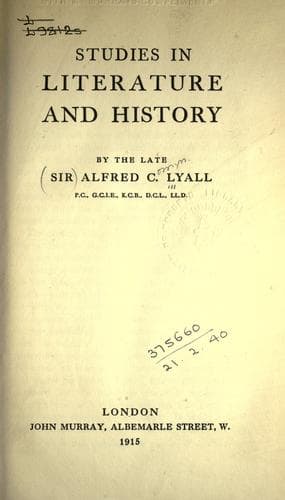
Studies in Literature and HistoryLyall, Alfred C., Sir
Religion
Studies in Literature and History
Lyall, Alfred C., Sir
English literature; History; Literature; Religion; Utilitarianism
This is true, stout-hearted, individualistic liberty of believing--an
excellent thing and wholesome, though it by no means covers the whole
ground, or meets all difficulties. The logical consequence is a strong
distaste for theology, and no very high opinion of the priesthood,
wherein we may probably find the root of Thackeray's proclivity,
already mentioned, toward unmerited sarcasm upon the clergy. In the
Introduction to _Pendennis_ is a letter written from Spa, in which he
says, 'They have got a Sunday service here in an extinct
gambling-house, and a clerical professor to perform, whom you have to
pay just like any other showman who comes.' It does not seem to have
occurred to Thackeray that the turning of a gambling-house into a
place of prayer is no bad thing of itself, or that you have no more
right to expect your religious services to be done for you in a
foreign land without payment than your newspapers or novels.
But these are blemishes or eccentricities which are only worth notice
in a character of exceptional interest and a writer of great
originality. Thackeray's work had a distinct influence on the light
literature of his generation, and possibly also on its manners, for it
is quite conceivable that one reason why his descriptions of snobbery
and shams appear to us now overdrawn, may be that his trenchant blows
at social idols did materially discredit the worship of them. His
literary style had the usual following of imitators who caught his
superficial form and missed the substance, as, for example, in the
habit which arose of talking with warm-hearted familiarity of great
eighteenth-century men, and parodying their conversation. It was easy
enough to speak of Johnson as 'Grand Old Samuel,' and to hob-nob with
Swift or Sterne, seeing that, like the lion's part in _Pyramus and
Thisbe_, 'you can do it extempore, for it is nothing but roaring.'
Thackeray will always stand in the front rank of the very remarkable
array of novelists who have illustrated the Victorian era; and this
new edition is a fresh proof that his reputation is undiminished, and
will long endure.
FOOTNOTES:
[10] _The Works of William Makepeace Thackeray, with Biographical
Introductions by his daughter_, Anne Ritchie. In 13 volumes. London,
1898.--_Edinburgh Review_, October 1898.
[11] Now Lady Ritchie.
THE ANGLO-INDIAN NOVELIST[12]
Public-domain text, read in full here on John Shaqi.
Reviews
Reviews
No reviews yet
Be the first to share your thoughts on this work.
Elsewhere in the archive
Join the Discussion
Join the discussion
Sign in to leave a comment or review.
Sign InorCreate an account