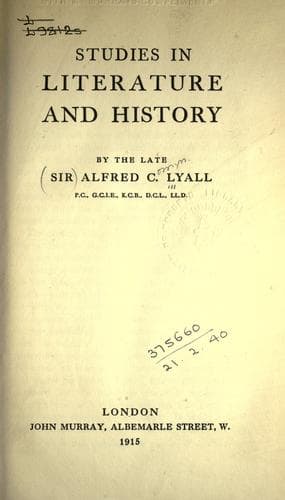
Studies in Literature and HistoryLyall, Alfred C., Sir
Religion
Studies in Literature and History
Lyall, Alfred C., Sir
English literature; History; Literature; Religion; Utilitarianism
For the last one hundred and fifty years India has been to Englishmen
an ever-widening field of incessant activity, military, commercial,
and administrative. They have been occupied, during a temporary
sojourn in that country, in acquiring and developing a great dominion.
No situation more unfavourable to the development of imaginative
literature could be found than that of a few thousand Europeans
isolated, far from home, among millions of Asiatics entirely different
from them in race, manners, and language. Their hands have been always
full of business, they have been absorbed in the affairs of war and
government, they have been cut off from the culture which is essential
to the growth of art and letters, they have had little time for
studying the antique and alien civilisation of the country. It seldom
happens that the men who play a part in historical events, or who
witness the sombre realities of war and serious politics, where
kingdoms and lives are at stake, have either leisure or inclination
for that picturesque side of things which lies at the source of most
poetry and romance. And thus it has naturally come to pass that while
Englishmen in India have produced histories full of matter, though
often deficient in composition, and have also written much upon
Oriental antiquities, laws, social institutions, and economy, they
have done little in the department of novels.
That a good novel should have been produced in India was, therefore,
until very recent times improbable; that it should have been
successful in England was still less to be expected. For the modern
reader will have nothing to do with a story full of outlandish scenes
and characters; he must be told what he thinks he knows; he must be
able to realise the points and the probabilities of a plot and of its
personages; he wants a tale that falls more or less within his
ordinary experience, or that tallies with his preconceived notions.
Accordingly, any close description of native Indian manners or people
is apt to lose interest in proportion as it is exact; its value as a
painting of life is usually discernible only by those who know the
country. The popular traditional East was long, and indeed still is,
that which has been for generations fixed in the imagination of
Western folk by the _Arabian Nights_, by the legends of Crusaders, and
by pictorial editions of the Old Testament. It is seen in the Oriental
landscape and figures presented by Walter Scott in _The Talisman_,
which every one, at least in youth, has read; whereas _The Surgeon's
Daughter_, where the scene is laid in India, is hardly read at all. Of
course there are other reasons why the former book is much more liked
than the latter; yet it was certainly not bad local colouring or
unreality of detail that damaged _The Surgeon's Daughter_, for Scott
knew quite as much about Mysore and Haidar Ali as he did about Syria
in the thirteenth century and Saladin. But in _The Talisman_ he was on
Public-domain text, read in full here on John Shaqi.
Reviews
Reviews
No reviews yet
Be the first to share your thoughts on this work.
Elsewhere in the archive
Join the Discussion
Join the discussion
Sign in to leave a comment or review.
Sign InorCreate an account