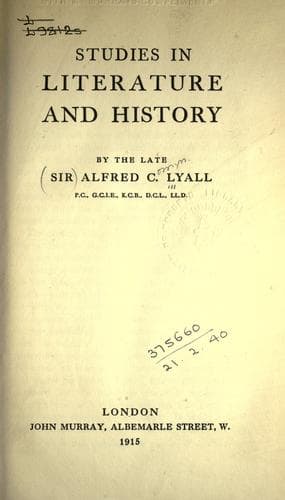
Studies in Literature and HistoryLyall, Alfred C., Sir
Religion
Studies in Literature and History
Lyall, Alfred C., Sir
English literature; History; Literature; Religion; Utilitarianism
Yet, notwithstanding the author's solicitude for India's welfare, the
natives make no figure at all in his story; they are barely mentioned,
except where Oakfield denounces the unblushing perjury committed daily
in our courts; and one can see that he does them the very common
injustice of measuring their conduct by an ideal standard of morality.
Anglo-Indian officials leave their country at an early age, in almost
total ignorance of the darker side of English life, as seen in a
police court or wherever the passions and interests of men come into
sharp conflict. But this is just the side of Indian life that is
brought prominently before them, at first, as junior magistrates and
revenue officers, who sometimes do not care to look into any other
aspects of it; and in consequence they stand aghast at the exhibition
of vice and false-swearing. A London magistrate transferred to Lucknow
or Lahore would find much less reason for astonishment.
The same criticism applies, for similar reasons, to Oakfield's
unmeasured censure of the tone and habits prevalent among officers of
the old Indian army; he probably knew nothing of regimental life in
the English army sixty years ago, and therefore supposed the
delinquencies of his own mess to be monstrous. It must be admitted,
however, that morals and manners were loose and low in a bad sepoy
regiment before the Mutiny. No two men could have differed more widely
in antecedents or character than William Arnold and John Lang, whose
novel, _The Wetherbys; or, A Few Chapters of Indian Experience_, was
written a few years earlier than _Oakfield_. It deals with precisely
the same scenes and society, at the same period, in the form of an
Indian officer's autobiography. The book is clever, amusing with a
touch of vulgarity, yet undoubtedly composed with a complete knowledge
of its subject; for Lang was the editor of a Meerut newspaper, who
took his full share of Anglo-Indian revelry, and who knew the Indian
army thoroughly. Whereas in _Oakfield_ the tone rises often to
righteous indignation, in _The Wetherbys_ it falls to a strain of
caustic humour, and in the modern reader's mouth it might leave an
unpleasant taste; yet the verisimilitude of the narrative would be
questioned by no competent judge. As Oakfield fought at Chillianwalla,
so Wetherby fights in the almost equally desperate battle of
Ferozeshah, where the English narrowly escaped a great disaster; and
here, again, we have a momentary ray of vivid light thrown upon the
battlefield by a writer who had associated with eye-witnesses, though
he was not one of them. It is difficult to give an extract from this
part of the tale, because Lang's power lies not in description, but in
characteristic conversation; so we may be content, for the purpose of
bringing out the contrast between two very diverse styles, with a
specimen of his comic talent, as exhibited in the injunctions laid
upon her husband by the vulgar half-caste wife of a poor henpecked
Public-domain text, read in full here on John Shaqi.
Reviews
Reviews
No reviews yet
Be the first to share your thoughts on this work.
Elsewhere in the archive
Join the Discussion
Join the discussion
Sign in to leave a comment or review.
Sign InorCreate an account