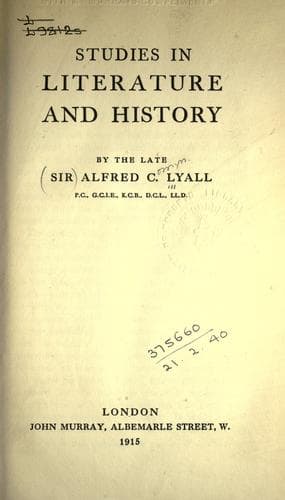
Studies in Literature and HistoryLyall, Alfred C., Sir
Religion
Studies in Literature and History
Lyall, Alfred C., Sir
English literature; History; Literature; Religion; Utilitarianism
officer just starting for the campaign:
'Well, then,' she continued, 'keep out of danger. If your troop
wishes to charge into a safe place, let 'em. _You_ don't want
brevet rank, or any of that nonsense, I hope. Make as much bluster
and row as you like, but for Heaven's sake keep out of harm's
way.... You need not write to me every day, but every third or
fourth day, for the postage is serious. If you should happen to
kill any Sikhs, search them, and pull down their back hair; that's
where they carry their money and jewels and valuables. A sergeant
of the 3rd Dragoons, like a good husband, has sent his wife down a
lot of gold mohurs and some precious stones that he found tied up
in the hair of a Sikh officer. And, by the by, you may as well
leave me your watch. You can always learn the time of day from
somebody; and if anything happened to you, it would be sold by the
Committee of Adjustment, and would fetch a mere nothing.'
This is unquestionably a grotesque caricature; yet the ladies of mixed
parentage were quaint and singular persons in the India of sixty years
ago. As Arnold could hardly have failed to read _The Wetherbys_ before
he wrote _Oakfield_, the book may have suggested to him the plan of
going over the same ground upon a higher plane of thought and
treatment. The two books stand as records of a state of society that
has now entirely passed away, and from their perusal we may conclude
that, among the many radical changes wrought upon India by the
sweeping cyclone of the great Mutiny, not the least of them has been a
thorough reformation of the native army.
Public-domain text, read in full here on John Shaqi.
Reviews
Reviews
No reviews yet
Be the first to share your thoughts on this work.
Elsewhere in the archive
Join the Discussion
Join the discussion
Sign in to leave a comment or review.
Sign InorCreate an account