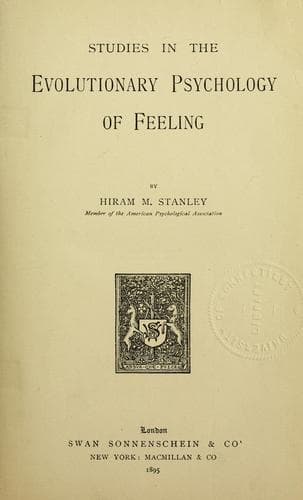
Studies in the Evolutionary Psychology of FeelingStanley, Hiram Miner
Philosophy
Studies in the Evolutionary Psychology of Feeling
Stanley, Hiram Miner
Emotions
The analogy of organic and psychic evolution may be pressed to a certain
extent. It is plainly possible to set in order an evolutionary series of
light—sensing organs, eyes—from most elementary to most complex, and it
is quite as possible, though yet to be done, to set forth in similar
genetic order a series of psychic states as offence-sense, _i.e._,
angers, in their increasing differentiation. But previous to any eye, to
local visualization, there is a period of common sensation when an
absolutely simple organism is in every part equally responsive to light;
in a crude way the whole organism reacts to light, from which stage by
traceable specialization the eye as a light-sensing organ is gradually
developed. Here analogy would seem to fail, unless we consider it to be
the stage when any psychosis, _e.g._, anger, requires the whole
consciousness capacity, mind being merely a capacity for the recurrent
but isolated single-activities. Mind certainly but slowly grows into
that sum of organic coincident interdependent yet distinct
consciousnesses which we commonly think of under the term, mind. Anger
in its very earliest and lowest form is no doubt an absorbing naïve
isolated wave, as common to mind as a whole, that is, as making up the
whole of mind for the time being, is perhaps in its measure an analogy
to common sensation. Anger may then be but a common emotion, answering
in a certain aspect to light-sense, sound-sense, etc., as purely common
sensations. But we must remark that general sensation is not to be
confounded with common sensation, or general emotion with common
emotion. Common sensations are, indeed, usually very general in form,
and a sensation _per se_, a purely general sensation, is probably very
rarely anything else, yet when we close the eyes and direct them toward
the sun, the general sensation of light we receive—very like the
original primitive common sensation—is general, yet by a special organ.
The word common refers, not to the special nature of the function
itself, but the fact that the function, whether special or general, is
performed indifferently, or practically so, by the common whole. A
sensation of coloured light is more special than a mere sensation of
light, and this than mere general sensation of force, but all may be
accomplished either by common sensation or special sensation. General
emotion may similarly be either common or in organic co-activity. There
was certainly a time when consciousness existed which was not and could
not be anger or fear or even an emotion _per se_. Pre-emotional and
pre-representative consciousness was so absolutely primitive, general,
and common, that psychology as a necessarily automorphic science will be
very long in coming to any understanding of this field, but yet we must
set it off as something which must always receive some consideration.
Anger is not a property of all consciousness by the nature of
consciousness itself, but is merely a possible mode dependent on
Public-domain text, read in full here on John Shaqi.
Reviews
Reviews
No reviews yet
Be the first to share your thoughts on this work.
Elsewhere in the archive
Join the Discussion
Join the discussion
Sign in to leave a comment or review.
Sign InorCreate an account