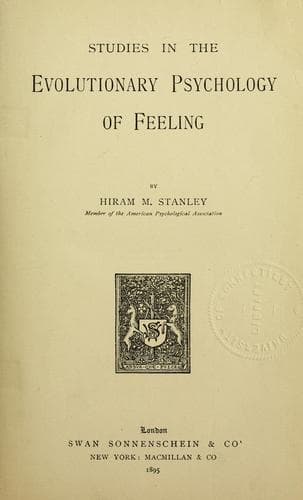
Studies in the Evolutionary Psychology of FeelingStanley, Hiram Miner
Philosophy
Studies in the Evolutionary Psychology of Feeling
Stanley, Hiram Miner
Emotions
circumstances for its development at a certain psychic stage.
What now is the inner nature and what the constituent elements of the
anger state? Comparatively few reflect upon their emotions save from an
ethical standpoint, and very few indeed attempt any analysis of them. To
determine the process and exact psychical constituents of getting mad
and being mad, may seem to many a quite useless and foolish
introspective endeavour. If a person is angry, he is angry, and that is
all there is of it, will be the general verdict of common sense. You can
dissect flowers into their parts, you can analyse rocks and soils, but
any emotion such as anger is wholly unanalyzable. No one can know what
it is to be mad until he has once been mad, and, thereafter, he can only
reflect upon it as a peculiar excitement, a powerful agitation, whose
occasions and results may be fully traced, but which in itself is _sui
generis_ and irresolvable. The form of consciousness we know as being
angry, is really a simple wave of emotion which stands by itself as an
elementary and ultimate form.
Suppose we acknowledge these remarks as true, we may yet maintain that
anger, like all emotions, is a highly complex state of manifold factors
whose sum total, whose grand resultant, is a seemingly simple and
peculiar _status_. Why should one arrangement of atoms produce a
peculiar perfume, another a peculiar stench? Anger may likewise be
merely an unexplainable _ensemble_ of early ascertainable elements.
Certain it is, in the first place, that sense of object is necessary to
anger. One cannot be mad without being mad _at_ something. The attitude
of mind is objective, and even rage in its blindest moment preserves
this attitude. Blind with rage, means no more than that various definite
qualities of the object are lost in the intense emotional reaction at
pain-giver. At its height, anger preserves, indeed, only the barest
apprehension of object; but this is intense and overpowering in
connection with the sense of it as infringing and injuring. In the
transports of rage and fury, the movements are wild and reckless enough,
but always antagonistic, implying outward destructive activity. Anger is
the fixation of the mind upon some object in its quality of personal
hurtfulness, and is revulsion, not _from_ it, as fear, but _against_ it.
With early psychisms, all perceptions of objects end in either anger or
fear, and a large part of early education consists in learning what
objects to be fearful of, and what to be angry at. The alertness of wild
animals is determined mainly by either nascent fear or anger. When a dog
is suddenly wakened from sleep he generally shows either fear or anger.
This is merely an illustration of how the dimmest sense of object
immediately connects itself with emotion as primitive and fundamental
tendency. The organism perceives the object, and representing its
imminent hurtfulness, feels fear and dashes away from it, or feels anger
and dashes against it.
Public-domain text, read in full here on John Shaqi.
Reviews
Reviews
No reviews yet
Be the first to share your thoughts on this work.
Elsewhere in the archive
Join the Discussion
Join the discussion
Sign in to leave a comment or review.
Sign InorCreate an account